
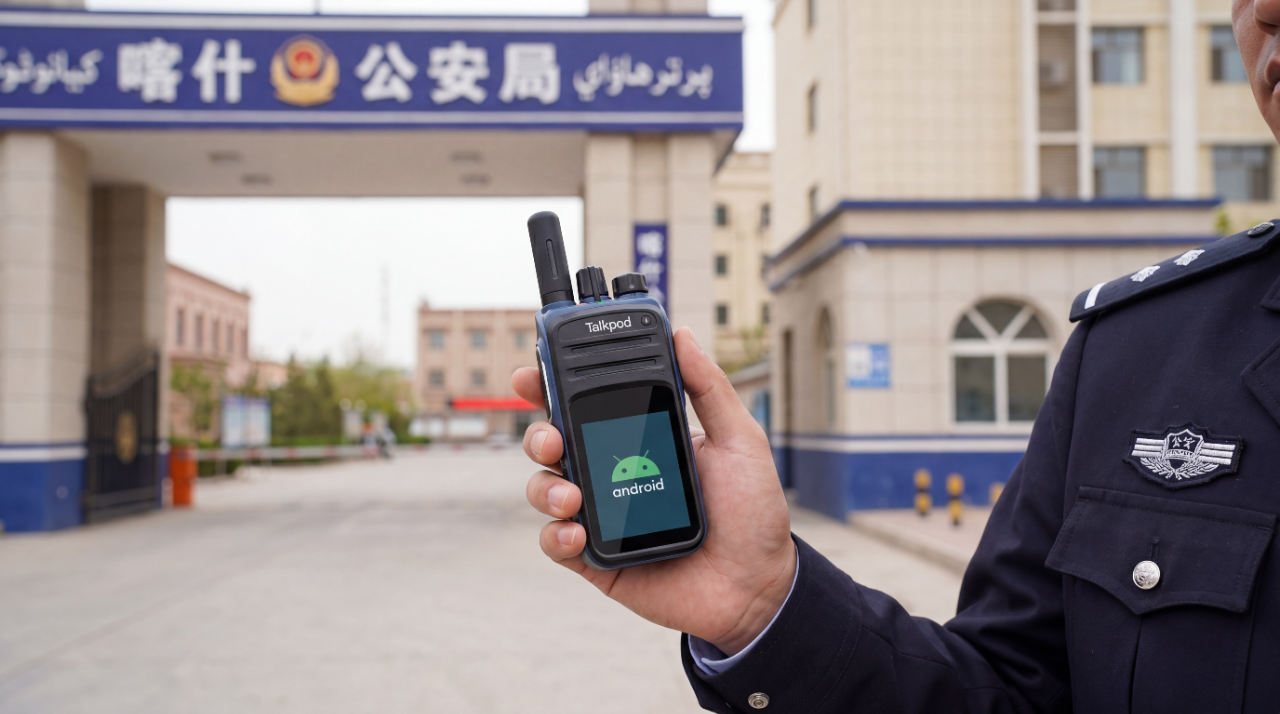
Distance is an everyday fact of border policing.
In the Kashgar region, personnel may be distributed across towns, rural communities, pastoral areas and mountainous terrain. A patrol can operate far from the command center, while another team remains at a fixed post and additional personnel cover a different part of the jurisdiction.
The challenge is not simply reaching farther. It is keeping those dispersed teams connected to the same operational picture.
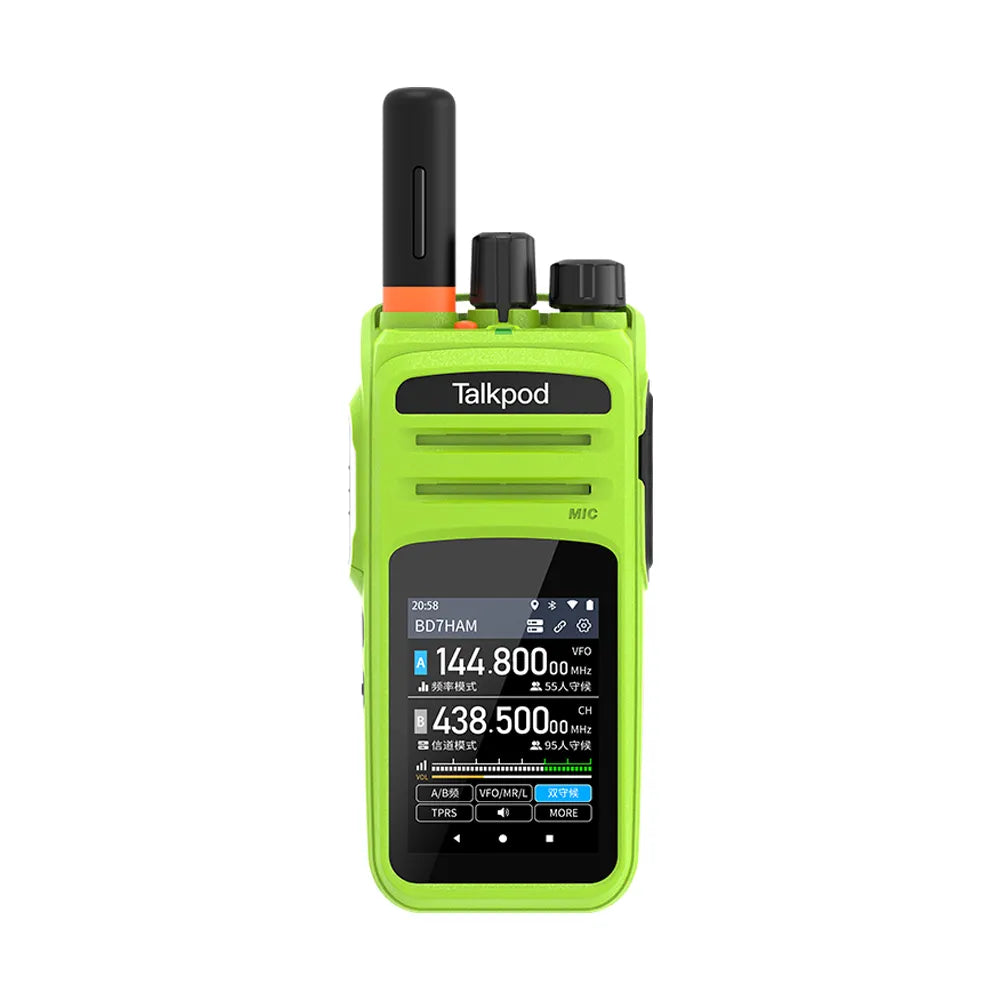
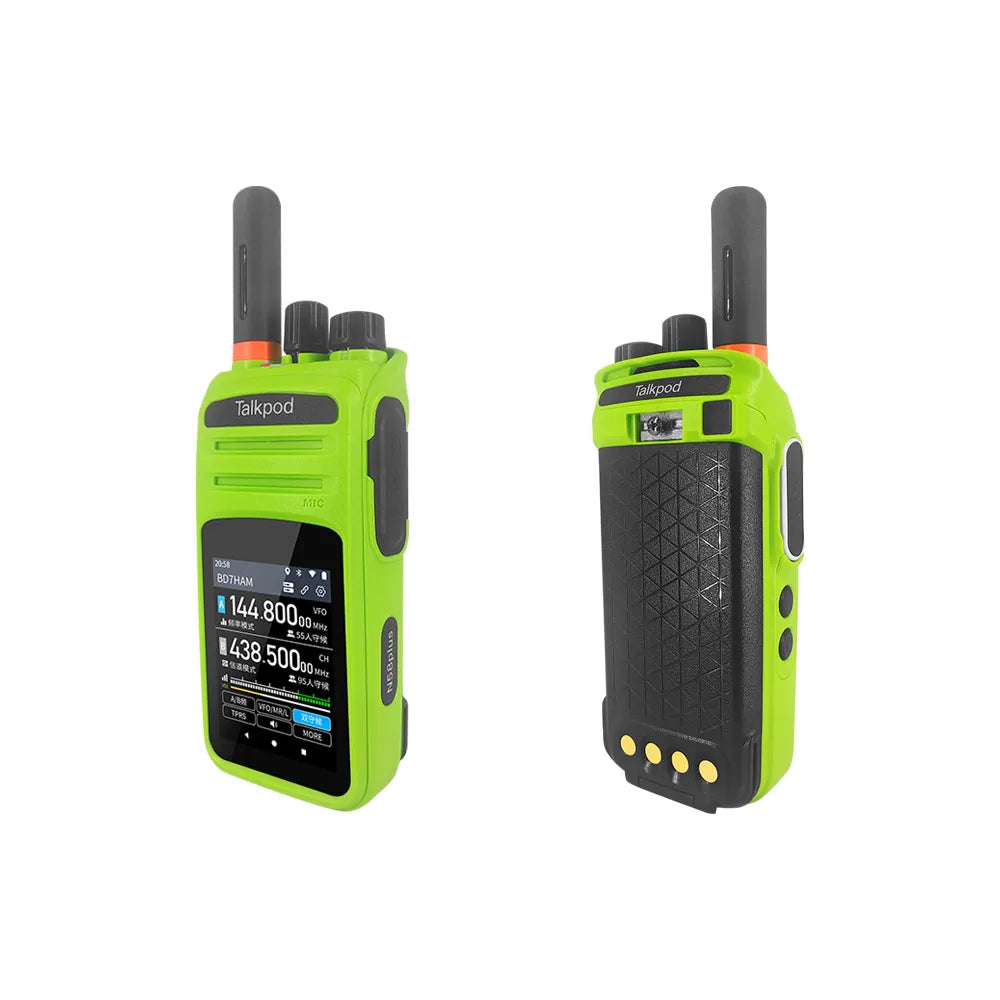
Conventional handheld radios remain useful for local communication, but mountains, distance and terrain can restrict direct radio links. The Talkpod N59 smart public-network radio provides an additional communication layer, combining wide-area push-to-talk with digital voice and front and rear cameras wherever suitable public mobile-network coverage is available.
Connecting dispersed patrols and fixed posts
Border policing often involves personnel working at widely separated locations.
One team may be conducting a routine patrol, another monitoring a fixed point, while supervisors coordinate activity from farther away. When the distance between users exceeds the practical range of a conventional handheld radio, communication becomes harder to maintain through a single local radio channel.
The N59 uses compatible public mobile networks to support wide-area push-to-talk communication.
Authorized personnel can remain within managed talk groups even when they are operating in different parts of the jurisdiction. Routine updates, requests for support and changes in local conditions can be passed without requiring every user to be within direct radio range of one another.
This makes the system particularly useful when policing activity is geographically dispersed.
It does not mean communication is unlimited.
Remote valleys, sparsely populated areas and mountainous routes may have weak or unavailable cellular service. Coverage should therefore be assessed along real patrol routes rather than assumed from general operator coverage maps.
Turning a field report into a clearer operational picture
Voice communication can tell a command center that conditions have changed.
Visual information can sometimes show how.
The N59 incorporates front and rear cameras that can support authorized image and video capture during field work. Where network conditions, platform configuration and departmental procedures permit, relevant visual information can be transmitted from the field to the command side.
This can provide supervisors with additional context during patrols or incident response.
Instead of relying entirely on a verbal description, the command side may be able to see the general terrain, road conditions or other circumstances affecting the team at the scene.
The objective is not to replace the officer's assessment. It is to give the people coordinating the response more information with which to understand it.
Managing visual information responsibly
A camera on a police communication device also creates responsibilities that an ordinary voice radio does not.
Images may contain identifiable people, vehicles, private property or other sensitive information. Capture, transmission, storage and access should therefore follow applicable law, departmental authorization, evidence rules and data-protection requirements.
Not every image recorded in the field automatically becomes formal evidence.
Whether a recording is retained or used for evidential purposes depends on the organisation's approved evidence-management process.
The N59 should therefore be integrated into established police information procedures rather than become an informal parallel recording system.
Clearer voice communication in difficult outdoor conditions
Border patrols can involve wind, vehicles, machinery and other sources of background noise.
In these environments, poor audio can turn a short instruction into several repeated calls.
The N59 uses digital voice processing and a high-output speaker to improve speech intelligibility under suitable conditions. This can help personnel exchange concise operational information while working outdoors.
Digital processing cannot remove every source of noise, however.
Strong wind, protective clothing, poor network conditions or the way a device is worn can still affect communication. Safety-critical information should therefore be confirmed according to established police procedures.
The purpose of clearer audio is to reduce avoidable misunderstanding, not eliminate the need for verification.
Public networks bring both range and dependency
The defining advantage of a public-network radio is also its main limitation.
Because the N59 uses compatible mobile networks, users do not have to remain within the direct radio range of one another. If both locations have suitable network service and access to the configured platform, communication can extend across much larger distances.
But the system also depends on that infrastructure.
In remote border areas, cellular coverage may vary significantly with terrain, population density and operator deployment. A patrol moving from a town into a mountain valley may experience very different network conditions within the same duty period.
That makes field testing essential.
Important patrol routes, fixed posts and known weak-signal areas should be evaluated in advance, with alternative communication procedures retained wherever connectivity cannot be relied upon.
For critical border operations, the N59 should complement rather than replace dedicated police radio, satellite communication or other mission-critical systems required by the organisation.
Supporting communication in demanding field environments
Equipment carried on long outdoor patrols has to cope with more than communication requirements.
Dust, wind, repeated handling and large temperature changes can place additional stress on handheld electronics.
The N59 is designed for demanding field use and has undergone environmental-reliability testing associated with conditions such as impact, vibration and temperature variation.
This supports routine outdoor deployment, but descriptions such as “military-grade” should not be interpreted as meaning the radio is immune to damage or suitable for every environmental condition.
Actual performance depends on the product's specified ratings and operating limits.
Cold weather can also reduce battery performance, while dust or physical damage may affect connectors, cameras and enclosures. Devices used regularly in harsh outdoor environments should therefore be inspected and maintained as part of the equipment-management process.
Training for officers working away from the station
A multi-function smart radio requires more than a brief introduction to the push-to-talk button.
Talkpod provided scenario-based operating guidance for personnel using the N59 in the field, with particular attention to straightforward operation under demanding outdoor conditions.
Training can cover which communication group should be used, when visual information is appropriate, how support should be requested and what to do when the public network becomes unavailable.
For personnel operating in mountainous or high-altitude areas, reducing unnecessary interaction with menus can also be valuable. A device should require as little attention as possible when the officer's primary focus must remain on the surrounding environment.
The aim is not to make policing dependent on more technology.
It is to make the technology easier to use when communication is already difficult.
Bringing the field and command side closer together
For a large border jurisdiction, the communication problem is not measured only in kilometres.
A greater problem is the delay between something happening in the field and the command side understanding what has happened.
The N59 helps reduce that delay where mobile-network service is available.
Field personnel can communicate through managed groups. Authorized images or video can provide additional context. Supervisors can coordinate teams spread across different locations without depending entirely on a direct handheld radio path.
The N59 cannot eliminate terrain, guarantee cellular coverage or replace dedicated mission-critical communication systems.
Its role is to make better use of the networks that are available and give dispersed personnel another way to remain connected.
In border policing, distance will always exist.
The more useful question is how much information that distance is allowed to hide.

Leave a comment
All comments are moderated before being published.
This site is protected by hCaptcha and the hCaptcha Privacy Policy and Terms of Service apply.