
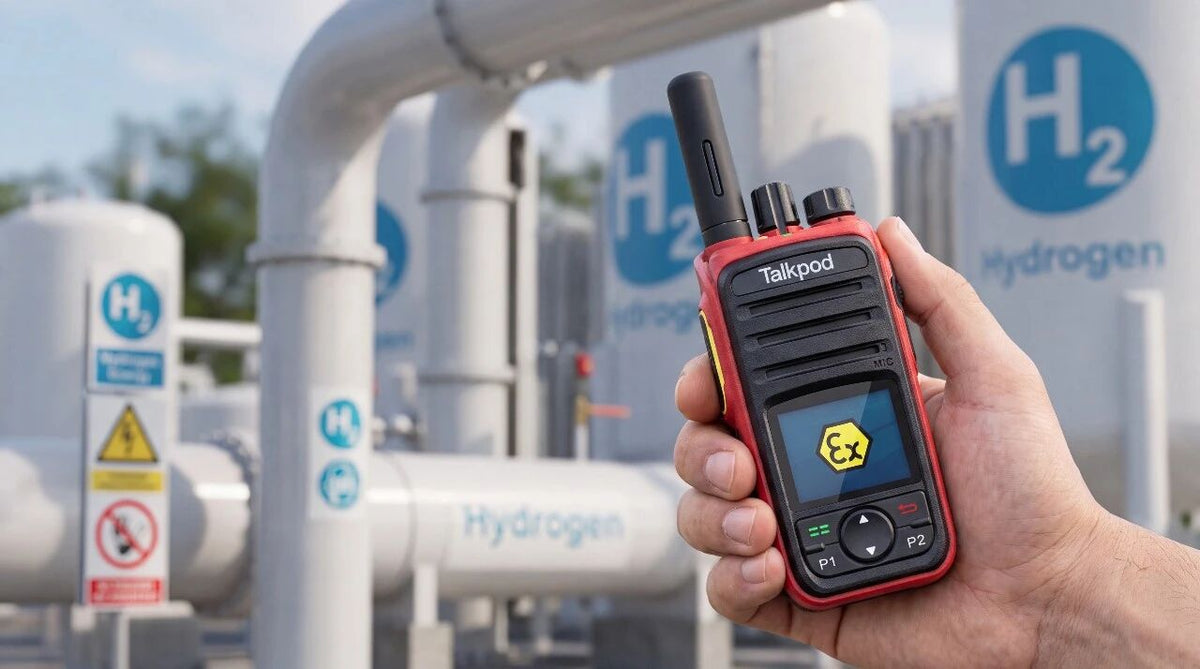
Hydrogen infrastructure creates an unusual communication challenge.
A single operation may involve a hydrogen production or storage site, tube-trailer transportation, refueling stations and fuel-cell testing facilities separated by considerable distance. At the same time, some of these locations may contain classified hazardous areas because hydrogen can escape rapidly from pressurized equipment and form a flammable atmosphere.
That means a communication device may need to solve two very different problems.
It must connect personnel across geographically separated sites, and it must be suitable for any hazardous location in which it is actually used.
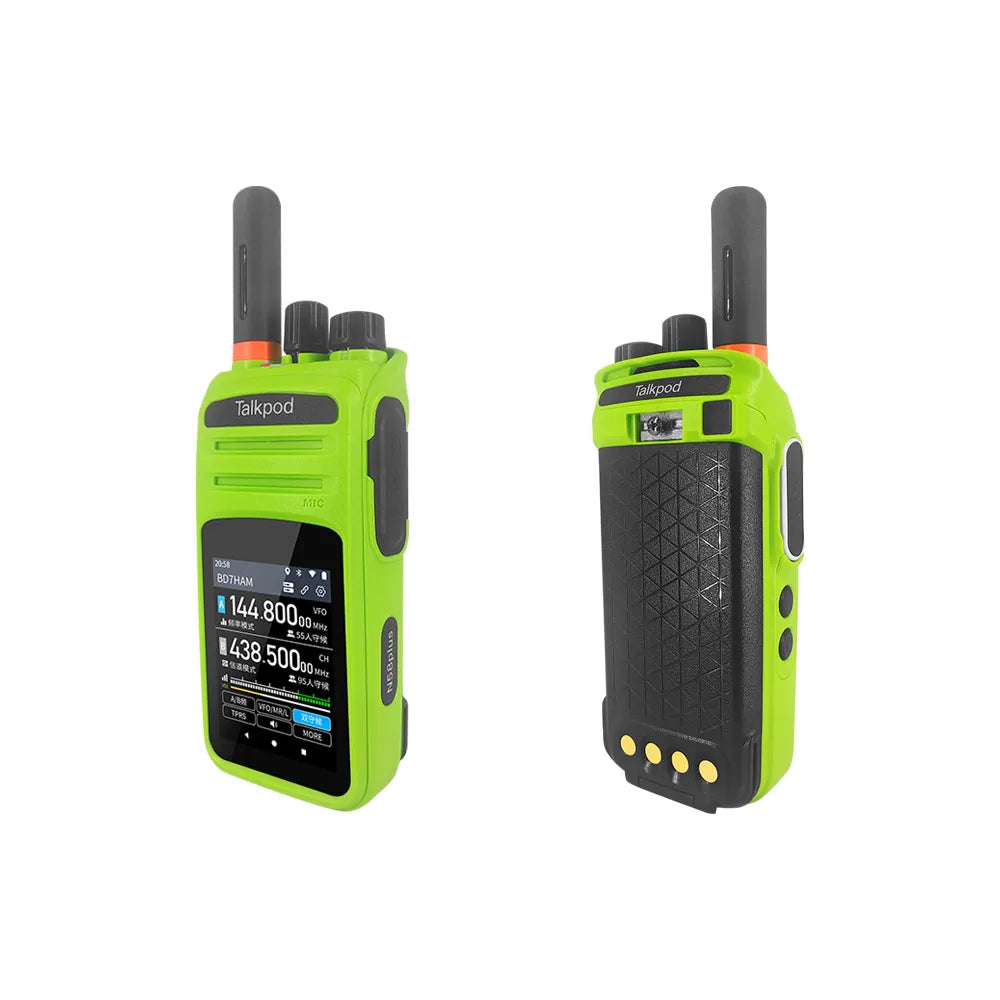
The Talkpod N56Ex explosion-protected public-network radio combines wide-area push-to-talk communication with positioning, managed groups and backend dispatch functions. Where compatible mobile-network coverage is available—and where the radio's exact certification matches the hydrogen hazardous area concerned—it can provide an additional communication layer across hydrogen production, storage, transportation and refueling operations.
[Image]
Hydrogen service requires specific hazardous-area verification
Hydrogen deserves particular attention when communication equipment is selected.
Its low ignition energy means electronic devices used in classified areas must meet the protection requirements applicable to the specific installation.
The source describes the N56Ex as using an intrinsically safe explosion-protection design. In practice, however, that description should be verified against the actual product certificate and nameplate before the device is introduced into a hydrogen facility.
Operators should confirm that the certification explicitly covers the required hazardous-area classification, gas group, temperature class and ambient operating conditions.
A certificate suitable for one industrial gas environment should not automatically be assumed to cover every hydrogen application.
Only approved batteries and accessories should be used. Charging, battery replacement and maintenance should follow the manufacturer's instructions and the facility's hazardous-area procedures, normally in an approved safe location unless the certification explicitly permits otherwise.
Explosion protection also has a limited meaning.
It does not make a hydrogen-rich atmosphere safe. It means the equipment is designed to avoid introducing an unacceptable ignition risk when operated within the conditions defined by its certification.
Connecting stations separated by long distances
Hydrogen distribution can extend well beyond the boundaries of a single facility.
A tube trailer may leave a storage or filling site, travel through urban or suburban areas and deliver hydrogen to a refueling station many kilometers away.
Conventional direct handheld radios cannot maintain that sort of link once the vehicle leaves their local coverage area.
The N56Ex uses compatible public mobile networks to carry push-to-talk traffic over much greater distances.
Where suitable coverage exists, transport personnel at a remote refueling station can communicate with a dispatch center without relying on direct radio range back to the originating site.
This can make it easier to report route delays, vehicle abnormalities or changes to delivery arrangements while the operation is still in progress.
The practical benefit is wide-area communication—not genuinely unlimited communication.
Tunnels, remote roads, dense structures and weak cellular areas can still interrupt service. Operators should therefore review actual transport routes and establish an alternative communication method for areas where public-network coverage is unreliable.
[Image]
Communication around hydrogen storage areas
Hydrogen storage facilities can include vessels, manifolds, compressors, valves and piping operating at elevated pressures.
If a leak occurs, personnel may need to report the condition quickly while following the site's established response procedures.
Where the N56Ex is certified for the specific hazardous area, it can provide a portable communication option for appropriately equipped personnel working around these installations.
That does not mean workers should remain unnecessarily in a known high-concentration hydrogen atmosphere simply because their radio is explosion protected.
Gas detection, ventilation, isolation and evacuation procedures determine whether personnel may safely remain in the area.
The radio supports communication within those procedures.
It does not change the exposure limits or make an unsafe location suitable for continued work.
Remote dispatch across several hydrogen sites
Hydrogen operations can involve personnel with very different responsibilities.
Storage operators, refueling-station staff, transport crews, maintenance technicians and emergency personnel may all need to communicate, but they do not need to hear every routine conversation.
The N56Ex supports managed and nested communication groups that can help structure traffic around these roles.
A normal refueling-station group can remain separate from transport operations, while authorized supervisors can coordinate several groups when an event affects more than one site.
The backend system can also help administrators manage users and communication permissions rather than treating every radio as an isolated device.
This becomes particularly useful when several locations need to respond to the same operational change.
The benefit is not simply more communication.
It is a more deliberate communication structure.
BeiDou positioning can provide dispatch context
The N56Ex supports BeiDou positioning, allowing authorized dispatch personnel to view available location information from equipped radios.
For hydrogen logistics, that can provide useful context.
A dispatcher may be able to see which equipped vehicle or field user is closest to a station requiring support, or identify the approximate location of a transport crew reporting an abnormal condition.
There are important limits.
The system is locating the radio, not independently tracking the worker, trailer or hydrogen asset if the device is no longer with it.
Satellite positioning also depends on adequate sky visibility. Performance can deteriorate inside buildings, beneath large structures or in heavily enclosed parts of a hydrogen facility.
For this reason, positioning should be treated as a dispatch aid rather than the sole source of personnel accountability or emergency location information.
[Image]
SOS alerts need a response procedure behind them
The N56Ex includes a prominent SOS control that can provide a quick way to send an alert to designated personnel or the dispatch platform.
That can be useful if an operator discovers a suspected hydrogen leak, abnormal pressure condition or another situation requiring immediate attention.
But pressing an SOS button does not itself manage the emergency.
The organization should define who receives the alert, how it is acknowledged, what location or user information is displayed and what action follows.
The feature also depends on device availability, network connectivity and platform configuration.
It should therefore complement—not replace—the facility's gas detection, fire and gas system, emergency shutdown, alarms, evacuation procedures and incident command arrangements.
Communication recording requires controlled use
The source also describes backend communication recording.
Where permitted by law, organizational policy and platform configuration, authorized recording may help operators review communications after an event, support training or reconstruct the sequence of routine coordination.
Access should still be controlled.
Recording permissions, retention periods and the handling of operational information should be governed through the organization's information-management procedures.
In a safety-sensitive industrial environment, recording is most useful when it forms part of a defined operational process rather than being treated as an unrestricted feature.
Hydrogen transport also requires driving discipline
Wide-area push-to-talk can help connect hydrogen transport crews with dispatch personnel, but communication should never create another road hazard.
Drivers should follow applicable laws and company procedures governing handheld device use while a vehicle is moving.
Where communication is required during transit, the operating procedure should define who handles the radio and when it can be used safely.
Pressure, valve status, cargo condition and other safety-critical transport information should also continue to be monitored and documented through the appropriate vehicle and hydrogen-transport systems.
The radio can help a crew report an abnormality.
It should not become the primary instrument for monitoring the hydrogen system itself.
[Image]
One layer within a hydrogen safety system
Communication matters during hydrogen operations, but it is only one part of the safety architecture.
Hydrogen detection, ventilation, pressure monitoring, grounding and bonding, emergency shutdown, fire protection, equipment inspection and controlled operating procedures all perform functions that a handheld radio cannot replace.
The Talkpod N56Ex occupies a narrower role.
Where suitable mobile-network coverage exists, it can connect personnel across hydrogen sites that are too far apart for conventional direct handheld communication. Where its exact explosion-protection certification explicitly matches the hydrogen hazardous area, it can also provide a communication option for appropriately classified locations.
Positioning, managed groups, backend dispatch and SOS alerts add further tools for coordinating dispersed teams.
Its value should therefore not be expressed as “borderless communication” or absolute protection in a hydrogen atmosphere.
A more credible benefit is the combination of wide-area coordination and correctly certified hazardous-area communication—giving hydrogen operators another way to keep people connected without confusing the communication system with the safety systems that control the hydrogen risk itself.





Leave a comment
All comments are moderated before being published.
This site is protected by hCaptcha and the hCaptcha Privacy Policy and Terms of Service apply.