
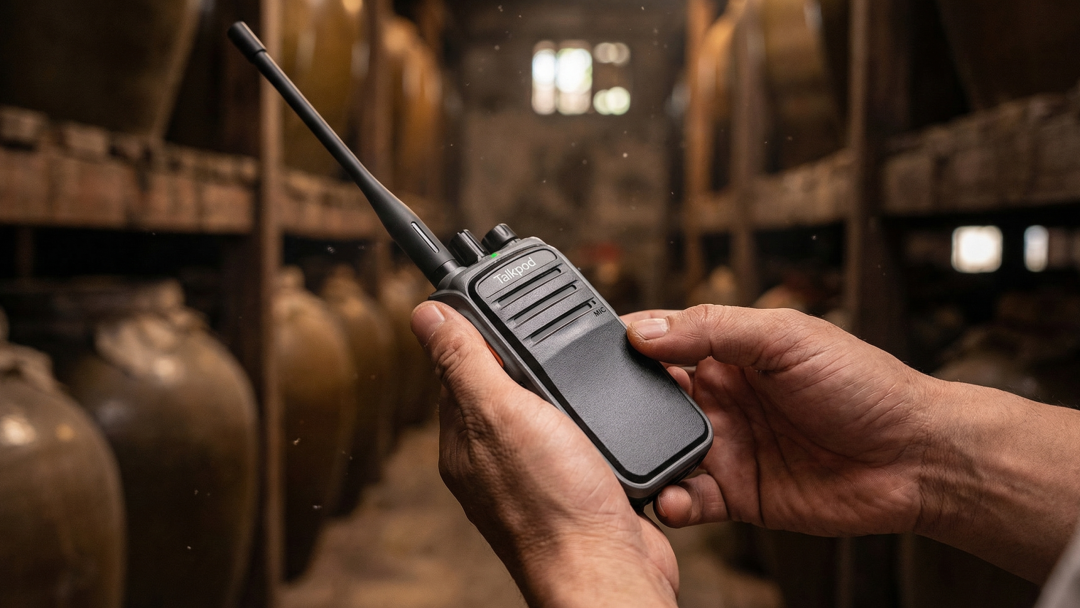
A large liquor warehouse creates an unusual radio environment.
Storage jars, shelving, walls and dense steel structures can divide a warehouse into many smaller RF spaces. A handheld radio that performs well near an entrance may become less reliable deeper inside the storage area, particularly when several rows of equipment and structural barriers sit between two users.
For warehouse personnel responsible for inspections, inventory movements and fire-safety checks, those communication gaps can become an operational problem.
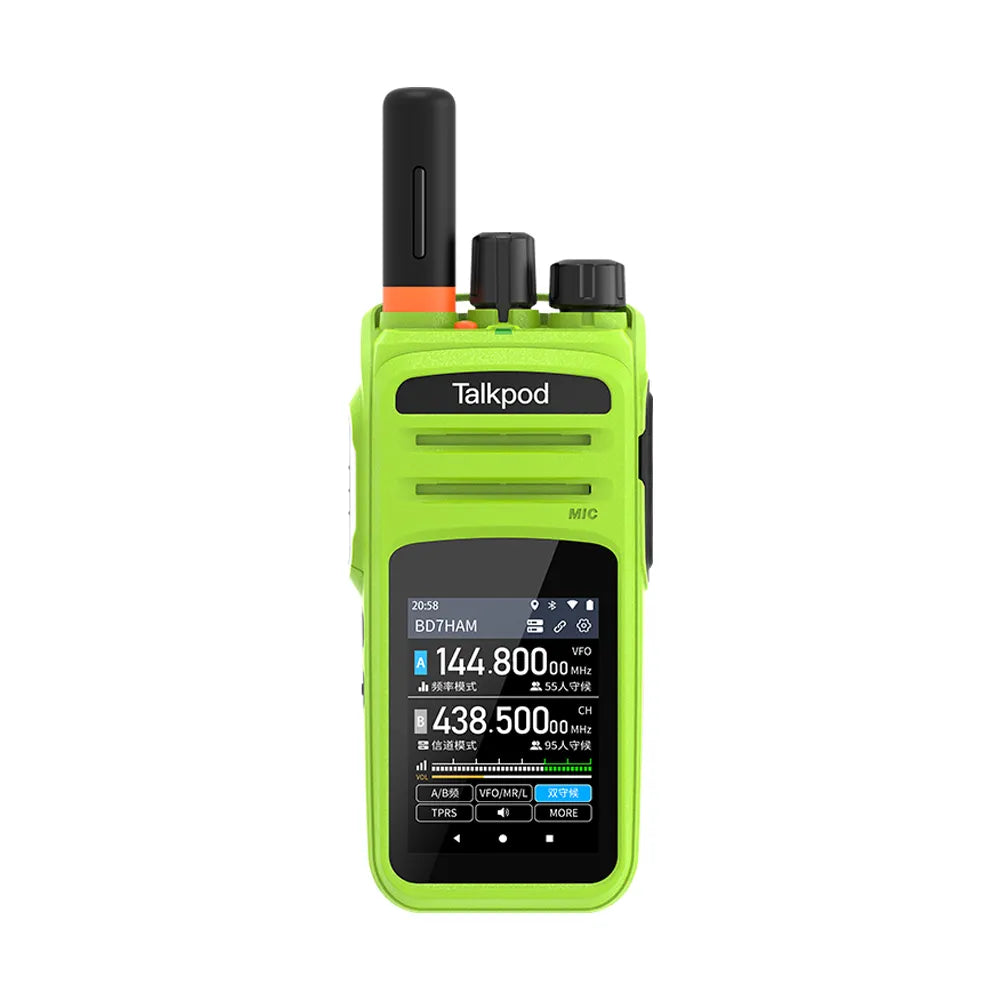
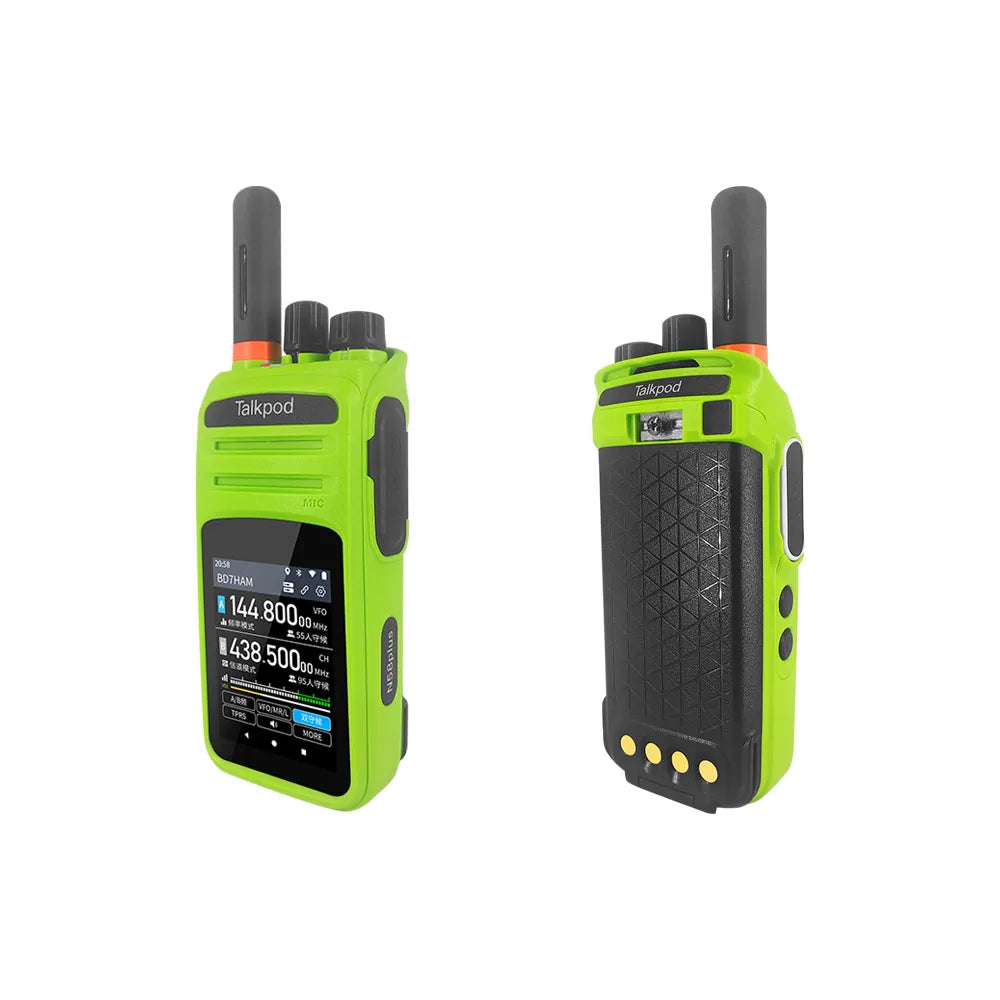
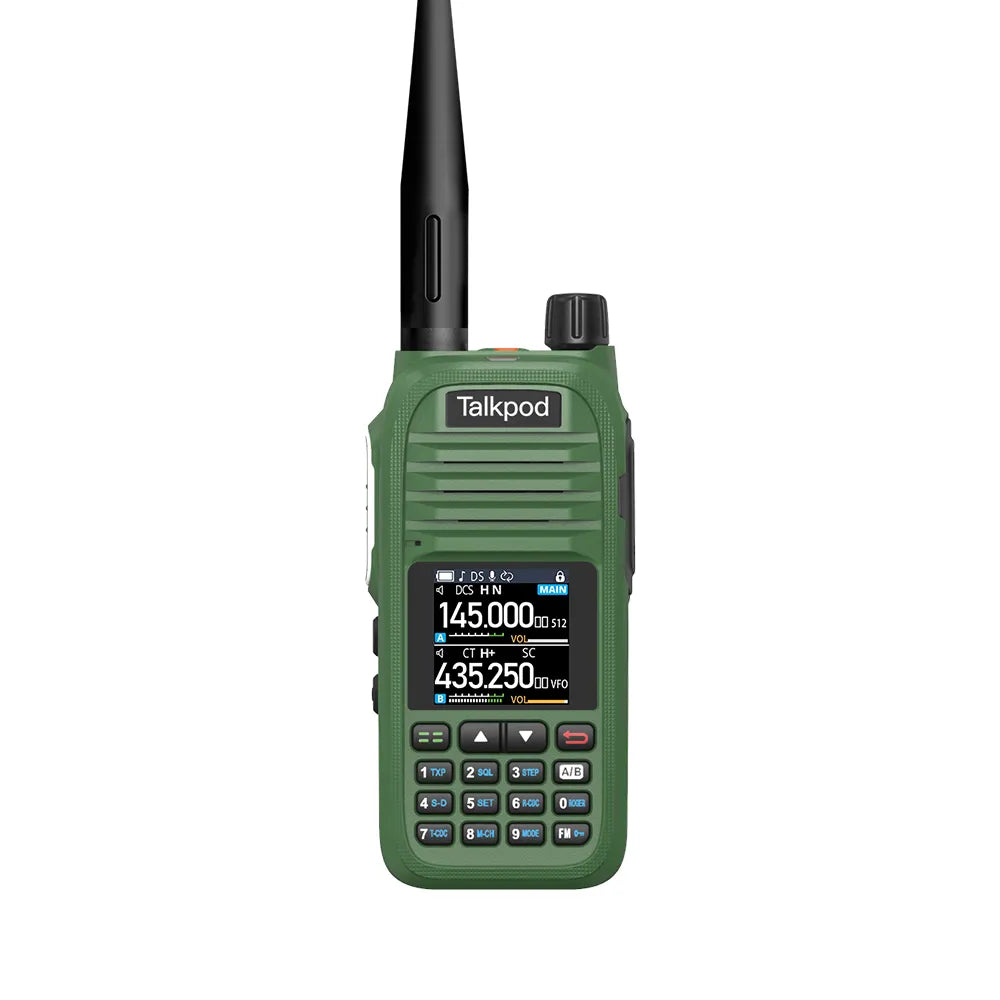
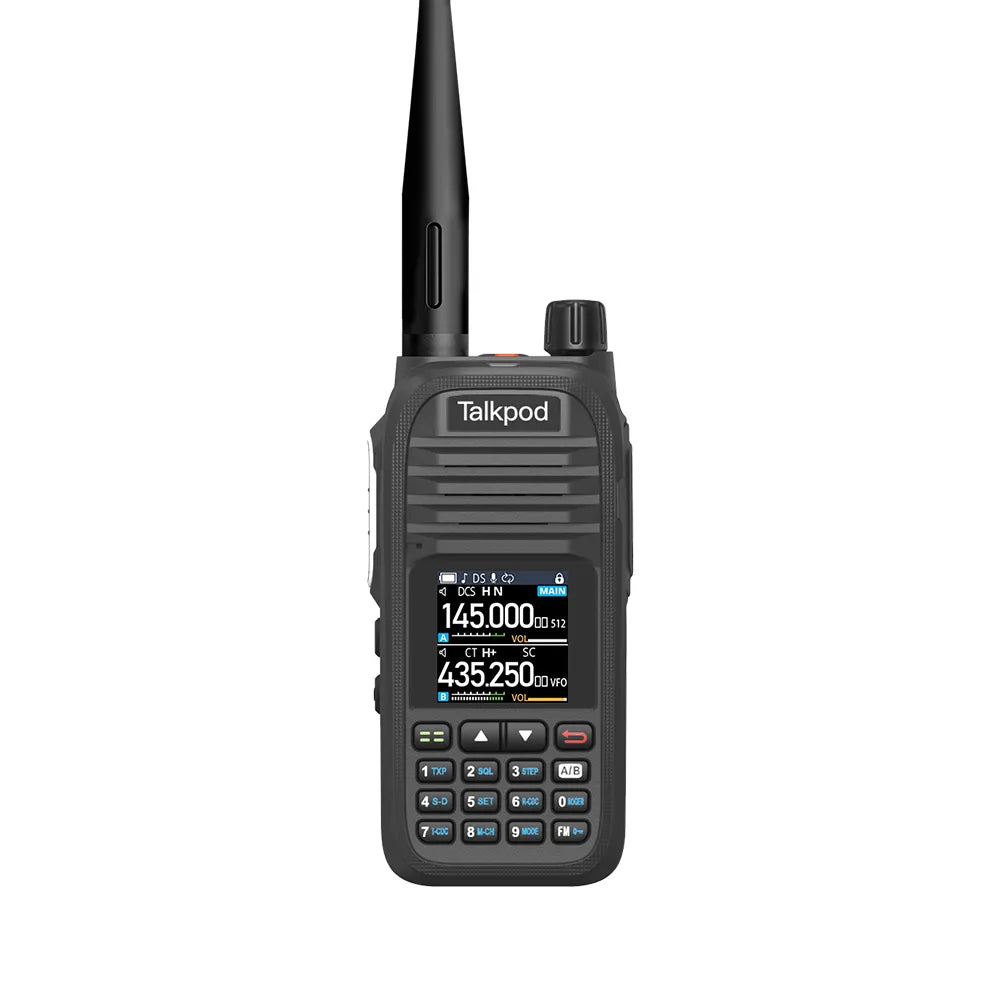
The Talkpod A50P digital ad hoc networking radio is designed to address this type of local coverage challenge without requiring a conventional fixed base station for the core network. Radios can automatically form a local network and relay voice traffic through other reachable devices, allowing the communication path to extend beyond a simple direct radio-to-radio link.
For a large liquor-storage operation such as Luzhou Laojiao’s, that can provide a more flexible way to connect personnel working across separated storage areas.
Dense storage structures make direct radio links difficult
Warehouses are rarely open RF environments.
Rows of storage vessels, steel racks, thick walls and separate rooms can all attenuate or reflect radio signals.
Traditional handheld radios depend heavily on the direct path between transmitting and receiving devices. Once that path becomes too weak, users may experience broken or unreliable communication.
The A50P approaches the problem differently.
Its ad hoc networking capability allows compatible radios to form a local network in which another device can act as an intermediate relay when a direct link is not sufficient.
That can help extend usable communication deeper into a complex warehouse layout.
It should not, however, be described as guaranteeing coverage in every corner.
Multi-hop networking still requires a viable radio path
Ad hoc networking does not remove the laws of RF propagation.
For a relay to work, each device in the communication path still needs to maintain a usable link with the next device.
If two storage areas are completely isolated by distance, reinforced construction or heavy shielding, simply adding one radio somewhere else in the warehouse will not necessarily solve the problem.
For the Luzhou Laojiao deployment, the more credible approach is the one described in the source: testing the warehouse layout and configuring the network around the actual storage environment.
Radios or designated relay positions can be arranged so that communication paths remain available between frequently used inspection areas.
Chain, mesh or other supported networking structures can then be selected according to the layout.
Good ad hoc coverage comes from planned device placement rather than a claim of “zero dead zones.”
Inspection teams can report without returning to a fixed point
Warehouse inspection involves a steady flow of small operational updates.
Personnel may be checking temperature and humidity records, looking for fire-safety hazards, confirming stock movement or verifying access to particular storage areas.
Without reliable local communication, an employee may need to walk back toward another part of the warehouse simply to report what has been found.
With an appropriately planned A50P network, inspectors can pass those updates directly to the relevant team while remaining on their route.
That can reduce unnecessary movement and shorten the time between identifying an issue and coordinating the next action.
The radio itself does not measure temperature, humidity or fire conditions.
Those readings must come from the warehouse’s approved environmental sensors, fire-detection systems and inspection procedures.
The A50P carries the worker’s report around those systems.
It does not replace them.
Work groups can reduce unnecessary radio traffic
A large warehouse may involve several different responsibilities at the same time.
Inspection personnel, inventory staff, security teams and supervisors do not necessarily need to hear every conversation.
The A50P can be configured with separate communication groups around these job roles.
That allows routine traffic to remain more focused while supervisors can coordinate between teams when required.
For the Luzhou Laojiao deployment, Talkpod customized group settings according to different warehouse responsibilities.
This kind of configuration is usually more useful than putting every employee into one common channel.
The objective is not to maximize the number of conversations.
It is to make sure the relevant people hear the information they actually need.
Encrypted voice should not be treated as absolute confidentiality
The source describes the A50P as supporting an encrypted communication mode.
That can provide an additional level of protection for operational voice traffic when the feature is properly configured.
But “encrypted” should not be translated into claims such as “information cannot leak” or “conversations cannot be intercepted.”
Communication security depends on implementation, configuration, key management and device control.
If a radio is lost, shared improperly or configured with weak access practices, technical encryption alone cannot solve the problem.
For commercially sensitive warehouse information, the organization should also consider what actually needs to be spoken over voice.
Inventory records, production data and other sensitive business information should remain within the company’s authorized management systems whenever possible.
The radio should carry the operational instruction—not every piece of commercial data behind it.
Liquor storage can introduce a separate safety question
A liquor warehouse is not automatically a hazardous-area environment simply because it stores alcoholic products.
But facilities handling high-concentration ethanol or areas where flammable alcohol vapor could accumulate may require a specific fire and explosion risk assessment.
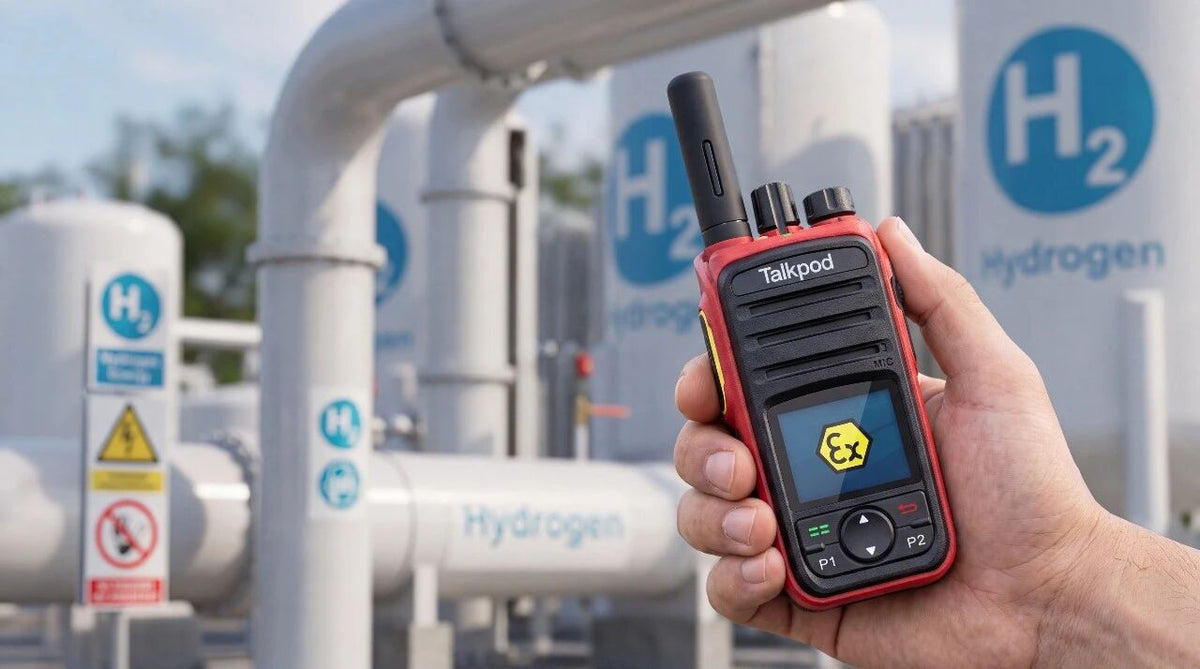
That distinction matters because the A50P is an ad hoc networking radio, not an explosion-protected model by default.
It should therefore not be introduced into a classified hazardous area simply because its communication performance is suitable for the warehouse layout.
The facility operator should determine where ordinary electrical equipment is permitted.
If particular storage, transfer or processing areas are classified for flammable vapor risk, communication equipment used there should have the corresponding hazardous-area approval.
Communication performance and explosion protection are separate engineering questions.
Fire safety remains independent of the radio network
Historic liquor storage represents a valuable asset, but communication alone does not protect it.
Fire detection, environmental monitoring, electrical safety, access control, inspection routines and emergency response procedures remain responsible for controlling the main risks within the warehouse.
The A50P can support those workflows by helping personnel report abnormalities and coordinate responses more quickly.
For example, an inspector who identifies a blocked fire route or unusual storage condition can contact the appropriate team without leaving the area.
That can make the response more efficient.
It does not turn the radio into a fire-safety system.
A network that can follow the warehouse layout
The main advantage of the Talkpod A50P in a large storage facility is its ability to build a local communication network without depending on one fixed conventional base station.
Automatic networking and multi-hop relay can help reduce some of the coverage problems created by dense shelving, steel structures and separated storage areas.
But the result depends on how the system is planned.
Device placement, warehouse geometry, distance and building materials all affect whether a reliable relay path can be maintained.
For Luzhou Laojiao, the practical value lies in combining that networking capability with site testing, role-based communication groups and ongoing configuration support.
The objective is not to promise a warehouse with no radio blind spots.
It is to create a communication layout that can adapt more effectively to a difficult storage environment—and help the people responsible for valuable inventory stay connected while the warehouse’s environmental, fire-safety and access-control systems continue to protect the assets themselves.


Leave a comment
All comments are moderated before being published.
This site is protected by hCaptcha and the hCaptcha Privacy Policy and Terms of Service apply.