
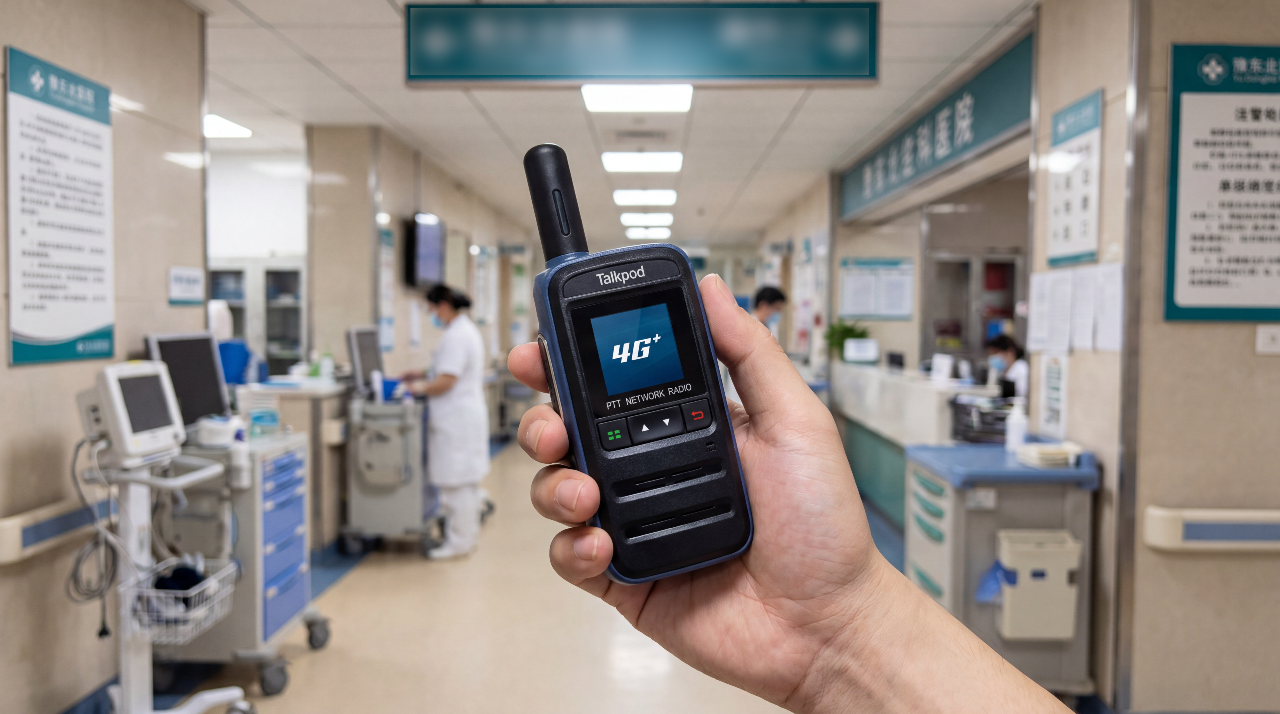
Hospitals are built around specialist departments. Patients, however, rarely fit neatly within one of them.
A critical case arriving in the emergency department may require anesthesiology, laboratory testing, pharmacy support and an operating room within a short period. Each department has its own staff, procedures and location. The difficulty lies in bringing them together quickly.
At Yudongbei Hospital, clinics, operating rooms, laboratories and support departments were distributed across a complex group of buildings. Walls, floors and medical equipment could affect conventional radio links, making communication between clinical, administrative and logistics teams less consistent.
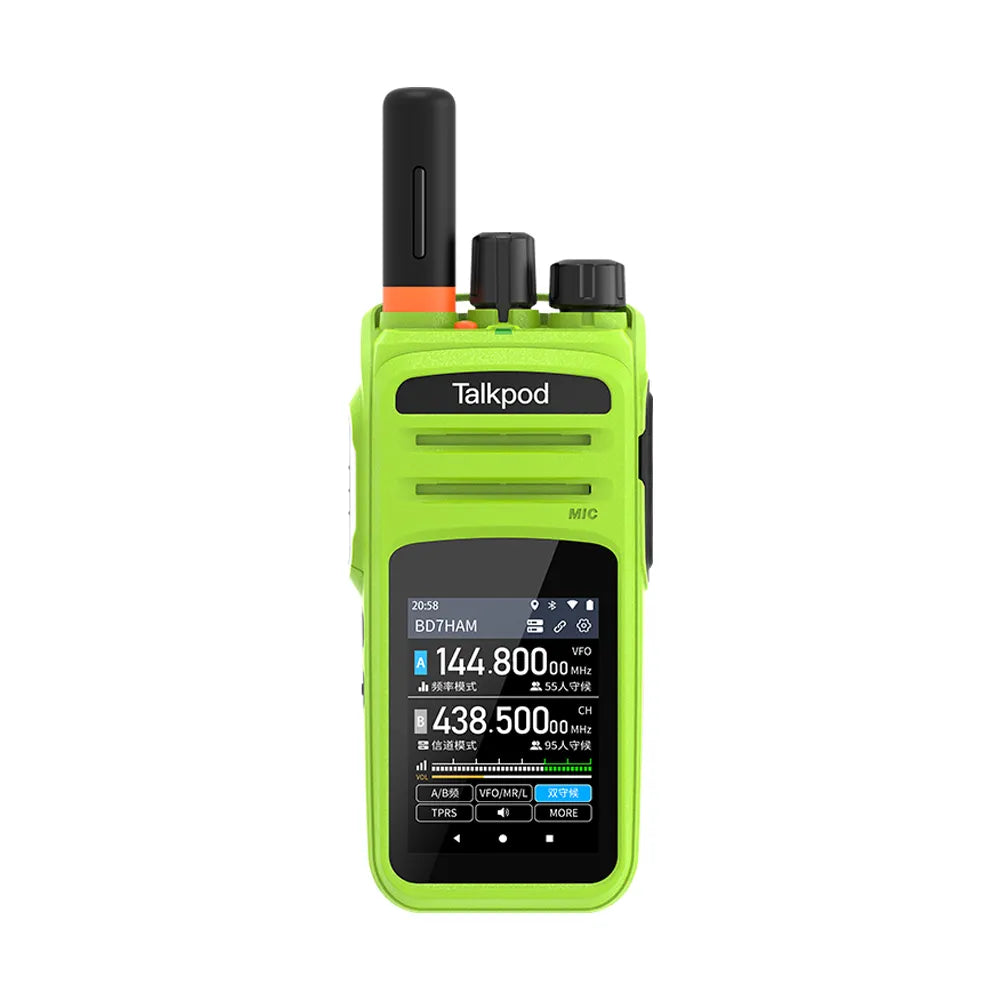
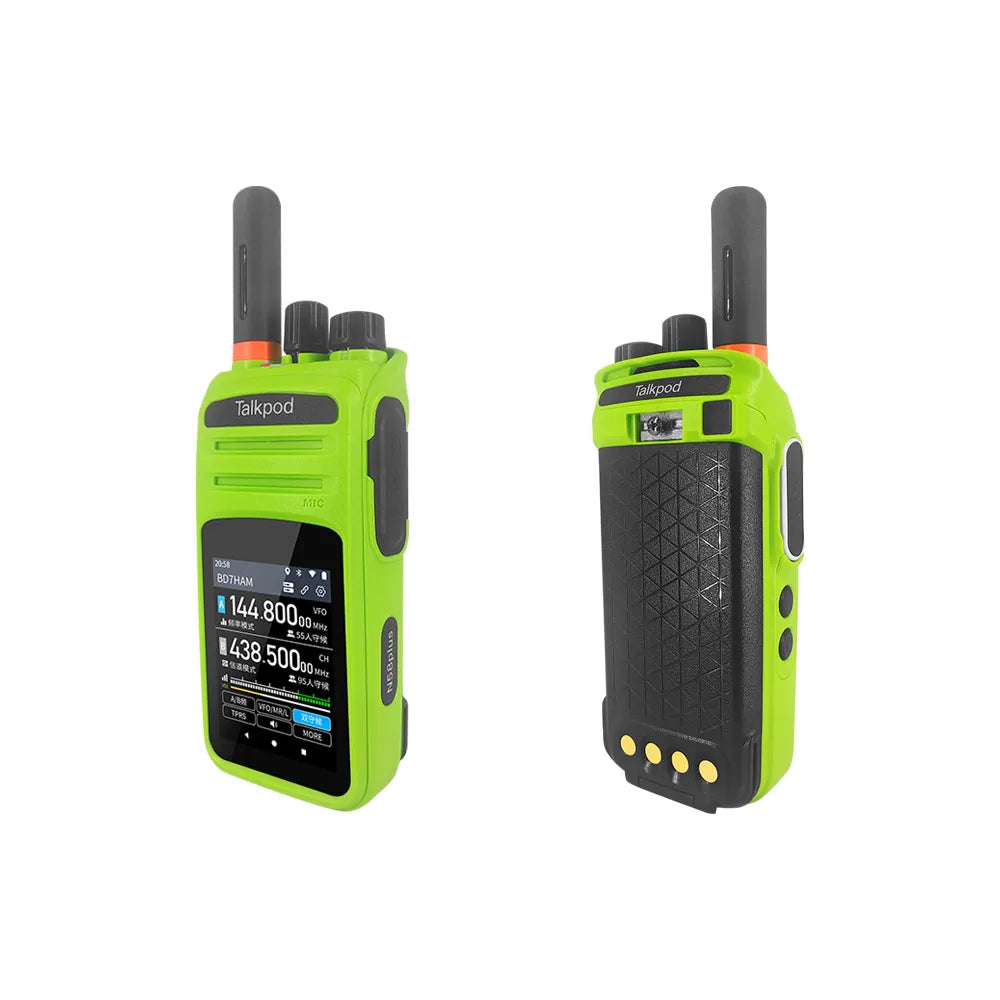
The Talkpod N15 public-network radio was introduced to provide an additional push-to-talk channel for coordinating personnel across the hospital wherever compatible mobile-network coverage is available.
Connecting departments around the patient
When a seriously ill patient arrives, communication often begins with a series of calls. Emergency staff contact one department, wait for a response and then repeat the process with another. Valuable time may be spent locating the right person rather than preparing the next stage of care.
With the N15, authorised users can be organised into communication groups based on department and responsibility. Emergency staff can contact supporting teams while remaining with the patient, rather than leaving the clinical area or repeatedly calling separate telephone numbers.
Anesthesiology, laboratory, pharmacy and logistics personnel can receive operational updates within the groups assigned to them. This helps departments begin their preparations sooner and gives the coordinating team a clearer way to confirm that requests have been received.
The radio does not replace formal clinical handovers, electronic medical records or hospital emergency-call systems. Its role is to shorten the operational communication surrounding them.
Making urgent communication easier to hear
Emergency halls and equipment rooms can be noisy. Patients, alarms, ventilation systems and moving equipment may make weak audio difficult to understand.
The N15 uses digital voice processing and a high-output speaker to provide louder and clearer communication. This can help staff understand short operational instructions, locations and requests for assistance without unnecessary repetition.
Clinical details must still be confirmed through approved procedures. A radio message should not become the sole record of a medication order, test result or treatment decision.
Its practical value is in rapid coordination: notifying the appropriate department, requesting equipment or confirming that personnel are on their way.
Organising routine and emergency communication separately
Hospital communication includes both ordinary work and urgent clinical response. Placing every user in one large group would create unnecessary traffic and increase the risk of important calls being overlooked.
Talkpod configured a nested group structure around the hospital’s departmental organisation. Routine reception and support work could remain within the appropriate groups, while emergency-response permissions allowed designated personnel to reach the teams needed for urgent cases.
This structure helped distinguish everyday communication from higher-priority coordination. It also reduced irrelevant calls for employees whose work was not connected to the incident.
Access must be managed carefully. Hospitals handle sensitive patient information, and radio communication should follow applicable privacy rules and internal confidentiality policies. Patient names, diagnoses and other identifiable details should be limited to what is operationally necessary and shared only with authorised personnel.
Testing communication inside a complex building
Public-network radios depend on mobile service. Hospital structures can complicate that service.
Reinforced walls, basements, imaging departments and rooms containing specialised equipment may weaken or block mobile signals. The N15 cannot guarantee continuous communication throughout every part of a medical campus simply because outdoor network coverage is available.
Coverage should therefore be tested across emergency departments, operating areas, laboratories, equipment rooms, lifts and other critical locations before deployment. Alternative hospital communication procedures must remain available wherever the network is weak or unavailable.
The N15 is best treated as an additional coordination layer, not as a replacement for dedicated clinical alarm systems, wired telephones or mission-critical emergency communications.
Training staff around real hospital scenarios
Introducing a communication device is not enough. Staff must know which group to use, what information to report and how to escalate an urgent request.
Talkpod provided scenario-based operating training for hospital personnel. Exercises reflected situations such as emergency admission, pre-operative preparation and cross-department support.
This helped employees practise the communication structure before using it during real clinical work. It also gave the hospital an opportunity to clarify permissions, calling procedures and the limits of what should be discussed over the radio.
For healthcare organisations, this preparation matters. Technology is most useful when it fits established clinical responsibilities rather than creating a separate and unfamiliar workflow.
Reducing the delays between departments
After deployment, hospital teams gained a more direct way to request cross-department support and coordinate operational preparations. Staff could remain at their posts while contacting the appropriate clinical or support group, reducing time spent searching for personnel or repeating the same request.
The N15 does not treat patients, interpret test results or make clinical decisions. It connects the people responsible for those tasks.
For Yudongbei Hospital, its value lies in reducing avoidable communication delays between departments. In healthcare, the most important work happens at the bedside. A well-designed communication system helps ensure that the people, equipment and support required there begin moving sooner.

Leave a comment
All comments are moderated before being published.
This site is protected by hCaptcha and the hCaptcha Privacy Policy and Terms of Service apply.