
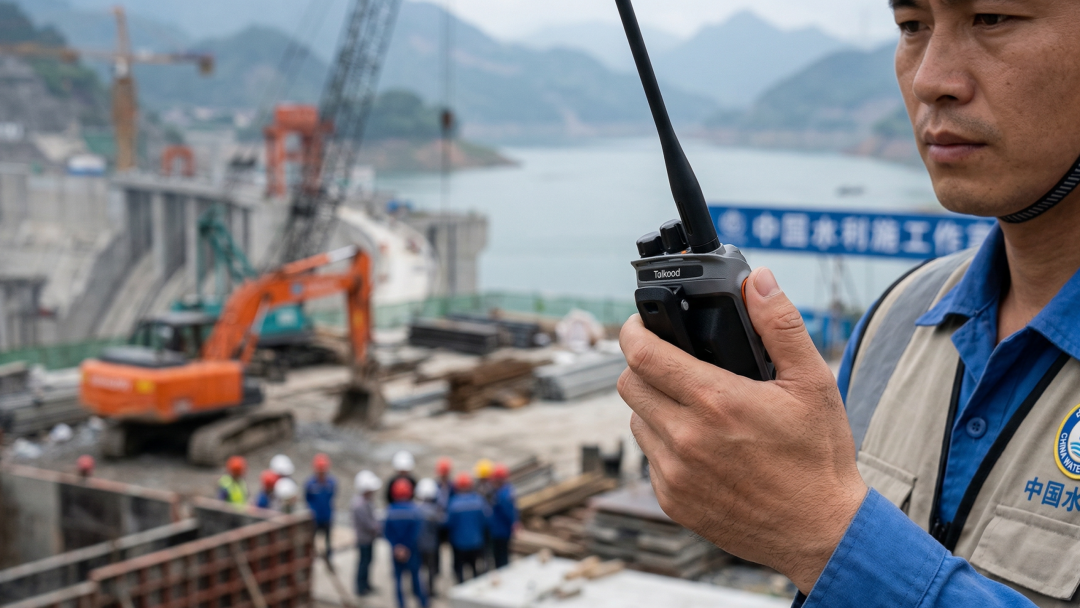
Water-conservancy construction often takes place where ordinary communication infrastructure is least useful.
Crews may be distributed across open countryside, mountain worksites, diversion tunnels, underground channels and partially completed structures. In some of these locations, public mobile coverage is weak or unavailable. In others, rock, concrete and tunnel geometry make direct handheld-radio communication unreliable.
For Henan No. 2 Water Conservancy Engineering Bureau, this creates a practical coordination problem: engineers and site personnel working at separate construction sections still need to exchange information about materials, concealed works, design changes and site conditions without repeatedly traveling back to a central office.
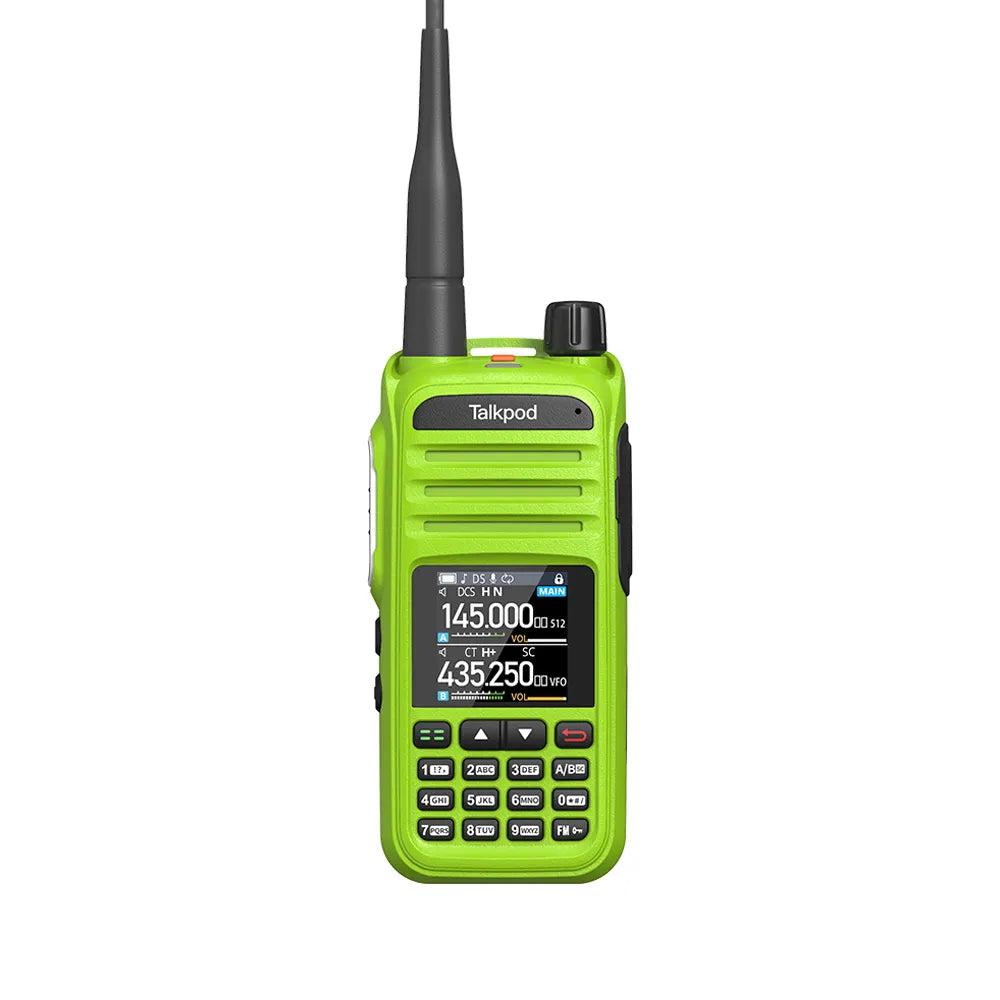
The Talkpod A50P digital ad hoc networking radio is designed for this type of local infrastructure-poor environment. It can automatically form a radio network without relying on a public mobile network or conventional fixed base station, while multi-hop relay allows communication to be extended through other reachable A50P units.
Communication where public networks are unavailable
Remote water projects frequently extend beyond normal cellular coverage.
A construction section may sit deep inside a mountain, along a rural diversion route or inside a tunnel where mobile-network signals disappear entirely.
A public-network radio is of limited value in that situation because it still depends on outside infrastructure.
The A50P takes a different approach.
Compatible radios can establish their own local network after startup, allowing personnel to communicate without depending on an operator's cellular service.
That makes the system useful for temporary or changing construction environments where installing permanent communication infrastructure would be impractical.
The advantage is infrastructure independence.
It should not be confused with unlimited range.
Multi-hop relay can extend communication around obstacles
A tunnel or mountainous construction site rarely provides a clear radio path from one end to the other.
Rock, concrete, bends and elevation changes can block or weaken direct RF communication.
The A50P supports multi-hop networking, allowing one radio to relay traffic toward another device farther along the route.
Depending on the site layout, chain, mesh or tree-style network structures can be used to organize those relay paths.
In a long diversion tunnel, for example, personnel positioned at several reachable points can help extend communication deeper into the works rather than requiring every user to maintain a direct link with the entrance.
This can reduce coverage gaps.
It does not make them impossible.
Each hop still requires a usable RF connection with the next device.
Tunnel communication has to be planned on site
Underground structures are particularly demanding radio environments.
Straight tunnel sections may provide relatively favorable propagation, while sharp bends, thick partitions, elevation changes and heavy construction machinery can weaken the signal quickly.
For this reason, a good A50P deployment should be based on an actual radio survey.
Relay positions can be tested at tunnel entrances, junctions, work faces and intermediate sections until a practical communication path is established.
As construction advances, that layout may need to change.
This is one of the advantages of an ad hoc system: the network can be adjusted by repositioning or adding compatible radios instead of rebuilding a fixed infrastructure system.
The most useful claim is therefore not “zero dead zones.”
It is that the network can be adapted more easily as the construction site changes.
[Image]
Faster reporting from dispersed construction sections
Communication on a water project is not limited to emergencies.
A cost engineer or site engineer may need to confirm material deliveries, verify concealed work before it is covered, report a field variation or coordinate measurements with another team.
When those personnel are working at different construction sections, repeatedly walking back to a central office wastes time.
With an appropriately configured A50P network, personnel can share short operational updates directly from the work area.
That can shorten the time between identifying an issue and getting the relevant engineer, supervisor or construction team involved.
Formal measurements, quantities, variation orders and acceptance records should still remain in the project's approved documentation and engineering-management systems.
The radio helps the team coordinate around those records.
It does not replace them.
Digital voice can improve intelligibility in construction noise
Water-conservancy sites can be noisy.
Excavation equipment, pumps, generators, ventilation systems and vehicle movement may all compete with radio audio.
Digital voice processing and noise-reduction functions can help improve speech intelligibility under these conditions.
That is useful when crews need to exchange short instructions without stopping work.
It should not, however, be described as eliminating all background noise or preventing every form of audio feedback.
Microphone position, speaker volume and the surrounding acoustic environment still matter.
Likewise, encryption and noise reduction serve different purposes.
Encryption can provide additional protection for voice traffic when properly configured, while digital noise reduction is the feature more directly related to speech clarity.
Group settings can separate different work teams
A large construction project may involve excavation, structural work, surveying, quality inspection, cost management and safety personnel at the same time.
Putting all of them on one communication group can create unnecessary traffic.
The A50P can be configured with separate groups for different construction sections or job functions.
For the Henan Water Conservancy deployment, Talkpod adjusted the communication structure around the project's actual working areas and provided practical training for relevant personnel.
That allows routine messages to remain within the team that needs them, while supervisors can coordinate across groups when necessary.
The objective is not simply to create more groups.
It is to reduce irrelevant radio traffic and make important messages easier to notice.
IP67 helps in wet and dusty work environments
Water-conservancy projects expose handheld equipment to conditions that are very different from an office.
Mud, dust, rain and splashing water may all be part of normal field use.
The A50P carries an IP67 rating, providing a defined level of protection against dust ingress and temporary water immersion under the conditions specified by the relevant standard.
That makes it better suited to wet and dusty construction environments.
It does not mean the radio is immune to every kind of water exposure or physical damage.
Ports, accessories and housings should still be inspected and maintained according to the manufacturer's instructions.
Ingress protection helps the radio survive the jobsite.
It does not remove the need for equipment care.
Communication should support construction safety procedures
A reliable radio network can help workers report unsafe conditions, coordinate access or request assistance more quickly.
But it does not create a safe construction site by itself.
Tunnel entry procedures, confined-space controls, ventilation, temporary electrical safety, lifting plans, fall protection and emergency evacuation arrangements all remain independent requirements.
The A50P can provide a voice path around those procedures.
If communication is considered essential for a particular high-risk activity, the project should also define what happens if a radio link is lost.
That may include designated relay positions, backup devices or another communication method depending on the risk assessment.
No radio system should be treated as the only safety barrier.
A network that can move with the project
Water-conservancy projects change continuously.
A tunnel advances. Access routes move. Temporary structures appear. Work teams shift between different sections.
A fixed communication design may therefore become less effective over time.
The Talkpod A50P is useful in this environment because its network can be reorganized as the site changes.
Automatic networking reduces dependence on external infrastructure, while multi-hop relay can extend communication through tunnels, mountainous terrain and separated construction areas when suitable relay positions are available.
For Henan No. 2 Water Conservancy Engineering Bureau, the practical value lies in combining those capabilities with site-specific network planning and user training.
The goal is not to claim communication everywhere under every condition.
It is to give a changing construction project a local radio network that can change with it—helping engineers and frontline teams remain better connected even where public mobile coverage is limited or unavailable.

Leave a comment
All comments are moderated before being published.
This site is protected by hCaptcha and the hCaptcha Privacy Policy and Terms of Service apply.