
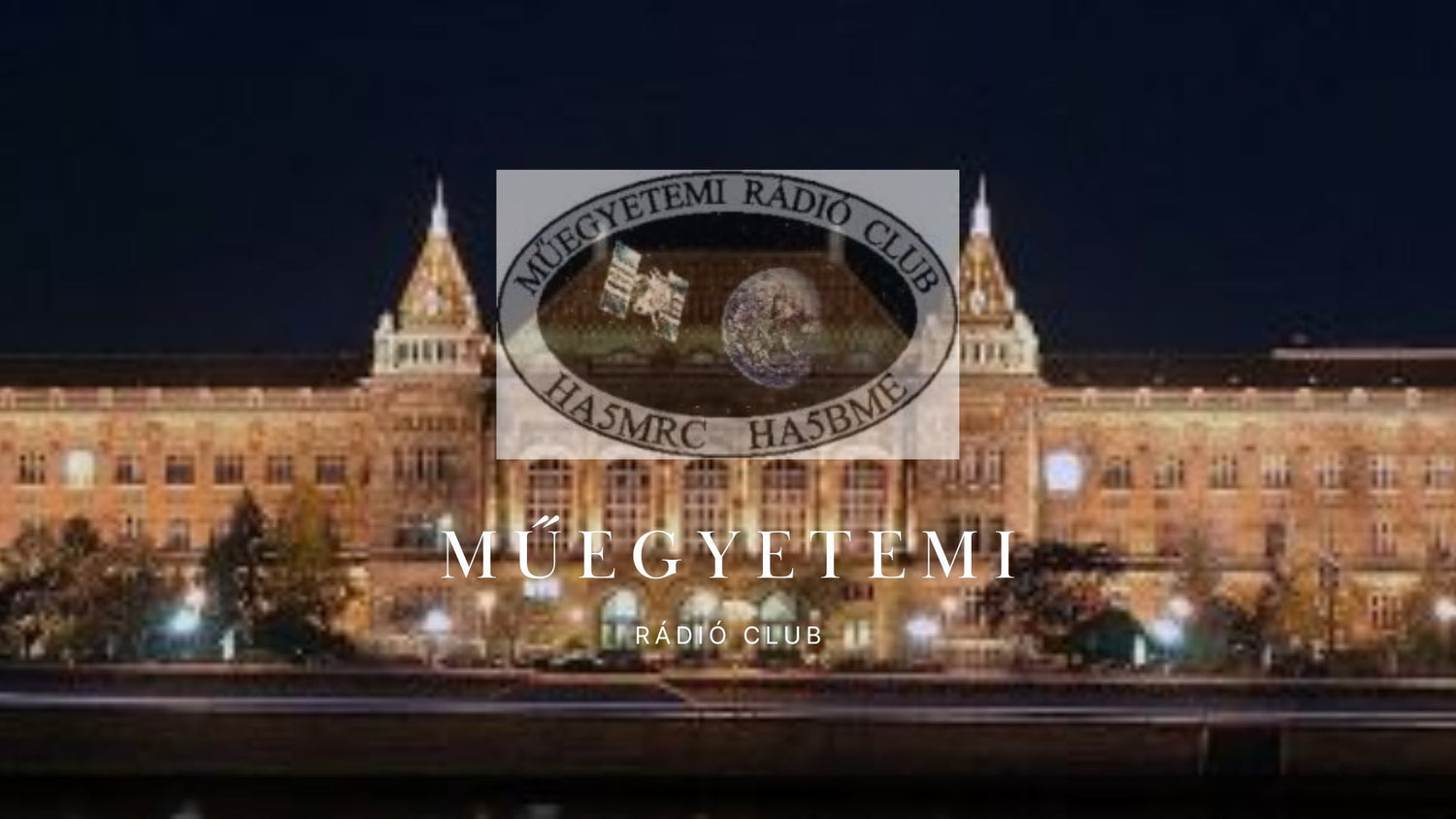
BUDAPEST, Hungary — Established on May 20, 1924, the Műegyetemi Rádió Club (MRC), operating under callsigns HA5MRC and HA5BME, is a venerable institution deeply intertwined with the Budapest University of Technology and Economics (BME). Located at Budapest XI. ker, Goldmann Gy. tér 3 (with its official registered address at 1111 Budapest, Egry József utca 18), the MRC is a non-profit organization dedicated to fostering technical advancement in amateur radio, particularly among engineering students and graduates. Its coordinates are approximately 47° 28′ 38″ N, 19° 03′ 27″ E.
The club's leader is Dr. András Gschwindt (HA5WH).
Nurturing Engineering Talent Through Amateur Radio
The primary goal of the MRC is to leverage the talents of young engineering students and graduate engineers to promote the technical development of amateur radio, explore new possibilities, and develop innovative solutions. This hands-on approach provides students with extensive theoretical and practical knowledge. Amateur radio, by definition, is a non-commercial activity driven by personal interest, self-training, technical development, and professional information exchange.
Membership in the MRC is exclusively open to students and graduates of the Budapest University of Technology and Economics. A significant advantage is that many incoming students gain foundational radio frequency knowledge at the Schönherz Zoltán Kollégiumi Rádióamatőr Klub (HA5KFU) before joining the MRC. This prior experience streamlines their advanced training and familiarizes them with equipment. The club also offers compelling, amateur radio-focused independent laboratory topics for students, often leading to diploma theses. Even after graduation, engineers can continue to engage with intriguing technical challenges, often collaborating with current students.
A Rich History of Contributions and Resilience
The MRC boasts a remarkable history:
- Founded on May 20, 1924, it initially served a dual purpose: self-training through amateur radio and practical support for university education.
- In the 1920s and 30s, aligning with the development of Hungarian telecommunications, the MRC began developing radio transceivers and audio frequency devices, significantly increasing its publication activity.
- Its activities were banned after the 1956 Revolution due to its communications support during the uprising.
- In 1975, under a new name (Budapesti Műszaki Egyetem KISZ-MHSZ Rádióklubja), and with a primary focus on satellites, the club fully resumed its amateur radio activities.
- The 1980s saw the club engaging with AMSAT Europe, leading to the development of on-board equipment that successfully operated on multiple satellites.
- Following the political changes in 1990, the club regained its original MRC name.
- A pivotal moment came in 2006 with the student-initiated development of MASAT-1, Hungary's first satellite, launched in 2012.
- Since 2012, building on the club's expertise, BME students and faculty have constructed five small satellites, including SMOG-P, the world's first and smallest working satellite at 5x5x5 cm.
- In 2023, the fifth and most complex BME satellite, MRC-100, was completed, named in honor of the club and its significant anniversary. It has been operating flawlessly since its launch, transmitting data. The control and data reception for these satellites are primarily handled by the radio station located on the roof of BME's "E" building.
- Beyond its own achievements, the MRC team has contributed its knowledge to various national and international projects, such as the development of SanoSat-1, a Nepali pico-satellite launched in January 2022.
Leadership and Training for Astronaut Candidates
Dr. András Gschwindt, an honorary associate professor at BME's Faculty of Electrical Engineering and Informatics (VIK), and a key professional leader of the satellite projects, has spearheaded BME's Space Research Group since 1970. His decades of outstanding work in Hungarian space research have earned him numerous accolades, including the Dénes Gábor Lifetime Achievement Award (2019), the Hungarian Order of Merit Middle Cross (Civilian Division) in 2021 for his small satellite developments, and the Magyari Endre Award from the NMHH (National Media and Infocommunications Authority of Hungary) on Telecommunications Day.
Significantly, MRC staff were also involved in the radio communication training and amateur radio exam preparation for Hungary's four astronaut candidates: Gyula Cserényi, Tibor Kapu, Ádám Schlégl, and András Szakály. These candidates were welcomed by Charaf Hassan, Dean of BME VIK, along with Dr. Gschwindt and Levente Dudás, professional leaders of the satellite projects.
Club Focus and Facilities
The MRC operates within the former Microwave Telecommunications Department, now known as the Department of Broadband Infocommunications, working closely with the Space Research Group, which heavily influences its development directions:
- Satellite communication
- Remotely controlled radio stations
- Digital signal processing
- Space-grade circuit design
The club's current equipment and university resources are extensive:
- T2FD shortwave antenna (east-west reception)
- Remotely controlled 3D rotator with satellite tracking antenna for 2-meter and 70-cm bands.
- Shortwave and ultrashortwave radio transceivers.
- Microwave converters and several parabolic antennas on the roof.
- Meteorological satellite receiving station + microwave antenna.
- Special, remotely controlled measuring receiver (Rohde & Schwarz).
- Radio frequency signal generators, analog and digital signal analyzers.
- Several desktop computers for development and education.
- Several control computers for radio control and automatic antenna rotation.
- Electromechanical manufacturing facility (limited use).
- PCB manufacturing facility (limited use).
Exciting Development Projects
The MRC is involved in various interesting development works:
- Creation and TCP/IP networking of phone repeater stations.
- Experiments and developments related to amateur radio packet radio networks.
- Power supply units for satellites and space probes.
- Meteorological satellite receiver circuits.
- Remotely controlled radio frequency measuring stations.
- Experiments with Digital Radio Mondiale (DRM) mode, a digital broadcasting method aimed at replacing AM broadcasting.
- Development of digital demodulators.
Education, Exam Prep, and Events
The club's core activities include:
- Advanced training for electrical engineering students in practical radio frequency and constructive aspects.
- Student constructive activities frequently culminate in diploma theses.
- Professional development for radio amateurs, including the annual "Műegyetemi szakmai nap" (University Professional Day).
The Műegyetemi Rádió Club continues its legacy of pioneering work in amateur radio, seamlessly integrating cutting-edge research with practical education and contributing significantly to Hungary's technological landscape and space endeavors.


Leave a comment
All comments are moderated before being published.
This site is protected by hCaptcha and the hCaptcha Privacy Policy and Terms of Service apply.