
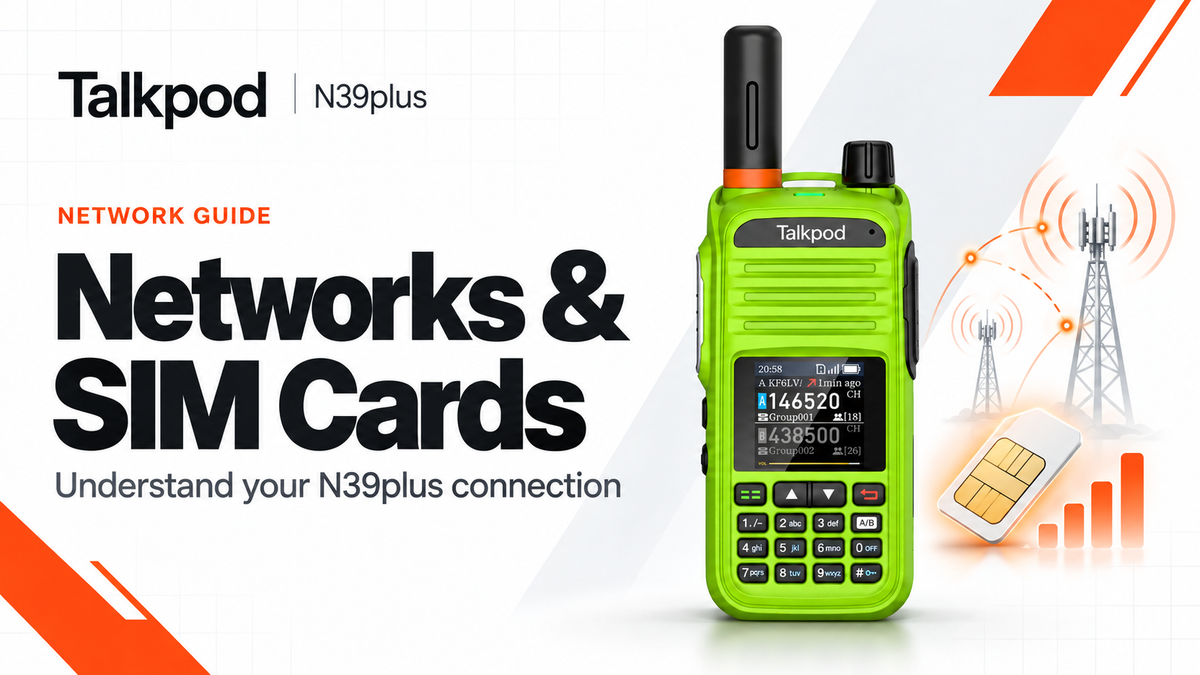
One of the key advantages of the Talkpod N39plus is that you do not need to manually select a cellular carrier every time you move between cities, regions, or supported countries.
With the Talkpod VHAM SIM installed, the N39plus is designed to automatically register with an available partner network and select an appropriate cellular connection.
For most users, there is no need to manually configure an APN, select a carrier, or change network settings.
In this guide, the Talkpod Team explains how VHAM SIM network selection works, which LTE bands are supported, and what users should know when traveling between regions.
No Manual Network Setup Required
The N39plus comes pre-configured for VHAM cellular connectivity.
During startup, the radio automatically:
-
Detects the installed SIM card
-
Searches for available cellular networks
-
Registers with a compatible partner network
-
Loads the appropriate network profile
-
Connects to the VHAM platform
Under normal circumstances, there is no need to manually enter an APN or select an operator.
Simply:
Install SIM → Attach Antenna → Power On → Wait for Network Registration
Once registration is complete, the N39plus can connect to the VHAM platform and begin receiving or transmitting through your selected talk group.
Automatic Carrier Selection
The VHAM SIM is designed to work with multiple cellular networks rather than relying on a single operator in every region.
When more than one compatible partner network is available, the radio and SIM service can select an available network automatically.
This can be particularly useful when traveling.
For example, when moving between cities or regions, the device may disconnect briefly from one cellular network and register with another available partner network.
A short interruption during this network handover can be normal.
The N39plus does not require the user to manually change the carrier each time this occurs.
Supported LTE Frequency Bands
The VHAM SIM service is designed primarily around 4G LTE connectivity.
Supported LTE bands include:
LTE-FDD
-
Band 1
-
Band 2
-
Band 3
-
Band 4
-
Band 5
-
Band 7
-
Band 8
-
Band 20
-
Band 28
-
Band 66
LTE-TDD
-
Band 34
-
Band 38
-
Band 39
-
Band 40
-
Band 41
Not every band is used in every country.
The radio will use the compatible bands available through supported local partner networks.
North America
🇺🇸 United States
The VHAM SIM can connect through supported cellular partner networks in the United States.
Depending on location, roaming agreements, network availability, and coverage, compatible networks may include major U.S. operators such as:
-
AT&T
-
T-Mobile
-
Verizon and associated roaming networks
Common LTE bands used by supported U.S. networks include:
B2 / B4 / B5 / B12 / B13 / B14 / B17 / B28 / B29 / B30 / B66 / B71
Actual network access and band selection are handled automatically by the device and SIM profile.
Users do not need to select these bands manually.
Important
Legacy U.S. 3G and CDMA networks have largely been retired.
The N39plus should therefore be considered primarily a 4G LTE PoC device for current U.S. operation.
🇨🇦 Canada
Supported partner networks may include major Canadian operators such as:
-
Bell
-
Rogers
-
Telus
-
SaskTel
-
Videotron
Canadian LTE networks commonly use bands such as:
B2 / B4 / B5 / B7 / B12 / B13 / B17 / B29
Coverage depends on the region and roaming availability.
The N39plus automatically searches for a compatible network when powered on.
🇲🇽 Mexico
Compatible networks may include:
-
AT&T Mexico
-
Telcel
-
Movistar
Common LTE bands in Mexico include:
B2 / B4 / B7 / B28
Actual carrier access depends on location, network availability, and the roaming profile associated with the VHAM SIM.
Europe
The European version of the N39plus is designed to operate across commonly deployed LTE bands used throughout Europe.
Important European LTE bands include:
B1 / B3 / B7 / B8 / B20 / B28
These bands provide a combination of:
-
Wide-area coverage
-
Urban capacity
-
Indoor penetration
-
Rural coverage
The exact carrier used depends on the country and available VHAM roaming partners.
🇬🇧 United Kingdom
Compatible networks may include operators such as:
-
Three
-
O2
-
Vodafone
-
Other supported roaming partners
The UK has now retired its 3G networks, so current N39plus operation should primarily rely on compatible 4G LTE coverage.
Common LTE bands include:
B1 / B3 / B7 / B20 / B28
🇮🇪 Ireland
Compatible partner networks may include operators such as:
-
Three Ireland
-
Eir
-
Vodafone Ireland
The device automatically selects an available supported cellular network.
🇩🇪 Germany
Compatible networks may include:
-
Deutsche Telekom
-
Vodafone
-
Telefónica / O2
Germany has already retired its major 3G networks.
Current N39plus operation therefore relies primarily on compatible LTE connectivity.
Common LTE bands include:
B1 / B3 / B7 / B8 / B20 / B28
🇫🇷 France
Compatible networks may include:
-
Orange
-
SFR
-
Bouygues Telecom
-
Free Mobile
The N39plus automatically searches for an available compatible partner network.
Commonly deployed LTE bands include:
B1 / B3 / B7 / B20 / B28
🇮🇹 Italy
Compatible networks may include:
-
TIM
-
Vodafone
-
Wind Tre
-
Iliad
Available bands and network access depend on local coverage and the VHAM SIM roaming profile.
🇪🇸 Spain
Compatible networks may include:
-
Movistar
-
Vodafone
-
Orange
-
Other supported roaming partners
The N39plus automatically registers with an available compatible network.
🇳🇱 Netherlands
Compatible networks may include:
-
KPN
-
Vodafone
-
Other supported roaming partners
Modern N39plus connectivity in the Netherlands should primarily be considered LTE-based as legacy mobile networks continue to be retired.
Why Doesn't My Radio Always Use the Same Carrier?
This is normal.
A roaming or multi-network SIM does not necessarily remain connected to one carrier at all times.
Network selection may change because of:
-
Signal strength
-
Network availability
-
Roaming agreements
-
Local coverage
-
Network congestion
-
Geographic location
For example, your N39plus may use one carrier at home and another partner network when traveling.
This does not affect your VHAM Group ID or Call Sign.
Your VHAM identity remains the same even when the underlying cellular carrier changes.
What Happens When I Travel?
When traveling between supported regions, the N39plus automatically searches for a compatible network.
A typical sequence is:
Current Network → Signal Lost → Network Search → New Partner Network → VHAM Reconnect
During this process, there may be a brief period when the radio shows no network connection.
Once a compatible network has been registered, the VHAM service should reconnect automatically.
You normally do not need to:
-
Change the APN
-
Select another carrier manually
-
Re-enter your Group ID
-
Re-register your VHAM account
What About 2G and 3G Networks?
Mobile carriers around the world are gradually retiring older 2G and 3G infrastructure and reallocating spectrum to newer LTE and 5G services.
For this reason, users should not rely on legacy 2G or 3G networks for N39plus operation.
The current VHAM service should primarily be considered a:
4G LTE Push-to-Talk over Cellular service
Where legacy networks remain available, compatibility may vary by country and carrier, but these networks should not be considered the primary connectivity method.
Frequently Asked Questions
Do I Need to Configure the APN Manually?
Normally, no.
With the official VHAM SIM, the N39plus automatically loads the required network settings and attempts to register with a compatible partner carrier.
Manual APN configuration should not be required during normal operation.
Do I Need to Choose AT&T, T-Mobile, Vodafone, or Another Carrier Myself?
No.
Carrier selection is normally automatic.
The SIM and radio search for an available compatible partner network based on your location and service profile.
What Happens If 3G Has Been Shut Down in My Country?
This is generally not a problem for normal N39plus operation because the current service is designed primarily around 4G LTE connectivity.
The radio will attempt to register with an available compatible LTE network.
It should not be assumed that a retired 3G network will remain available as a fallback.
Does the N39plus Support 5G?
The N39plus itself is primarily a 4G LTE PoC radio.
It does not require a 5G connection to use VHAM.
Even in areas where carriers advertise 5G service, their LTE networks normally continue to provide the data connectivity required by compatible 4G devices.
Will the Radio Always Connect to the Strongest Carrier?
Not necessarily.
Network selection depends on several factors, including:
-
SIM roaming configuration
-
Available partner networks
-
Signal quality
-
Carrier policies
-
Local network availability
The device attempts to connect to a suitable supported network, but this does not always mean the network showing the highest raw signal level.
What Should I Do If the Radio Cannot Register on a Network?
First:
-
Make sure the 4G antenna is installed correctly.
-
Move to an area with stronger cellular coverage.
-
Restart the radio.
-
Allow several minutes for network registration.
If the device still cannot connect, check the diagnostic or QR-code information displayed by the N39plus and contact:
Include your device information and ICCID when contacting support.
Using a Third-Party SIM Card
The N39plus can also support compatible third-party data SIM cards.
However, compatibility depends on both the cellular network and the type of data service provided by the SIM.
For best compatibility, the SIM should provide standard IP data access.
Some specialized IoT SIM cards restrict communication to specific servers or IP addresses. If you use such a SIM, you may need to contact the SIM provider to confirm that VHAM network traffic is permitted.
Users installing a third-party SIM may also need to configure the appropriate APN manually.
The automatic VHAM SIM configuration described in this article applies primarily to the official Talkpod VHAM SIM service.
Cellular Coverage Determines PoC Coverage
Unlike a conventional VHF/UHF handheld radio, the N39plus does not communicate directly from radio to radio over RF.
Its communication path is:
N39plus → Cellular Network → Internet/VHAM Server → Cellular Network → Receiving Device
This allows users to communicate over much greater geographic distances than direct handheld RF communication.
However, at least one compatible cellular data network must be available at each user's location.
If there is no compatible cellular coverage, VHAM communication will not be available until the device reconnects to a supported network.
Designed to Keep Network Setup Simple
For most N39plus users, there is no need to understand every LTE frequency band or roaming agreement behind the service.
The basic process remains:
Power On → Automatic Network Search → VHAM Login → Select Group → Press PTT
The N39plus and VHAM SIM handle most cellular-network selection automatically in the background.
This allows users to focus on communication rather than carrier configuration.
For more information about N39plus activation, SIM service renewal, network troubleshooting, and VHAM operation, please visit the Talkpod Support Center.
Talkpod Team

Leave a comment
All comments are moderated before being published.
This site is protected by hCaptcha and the hCaptcha Privacy Policy and Terms of Service apply.