
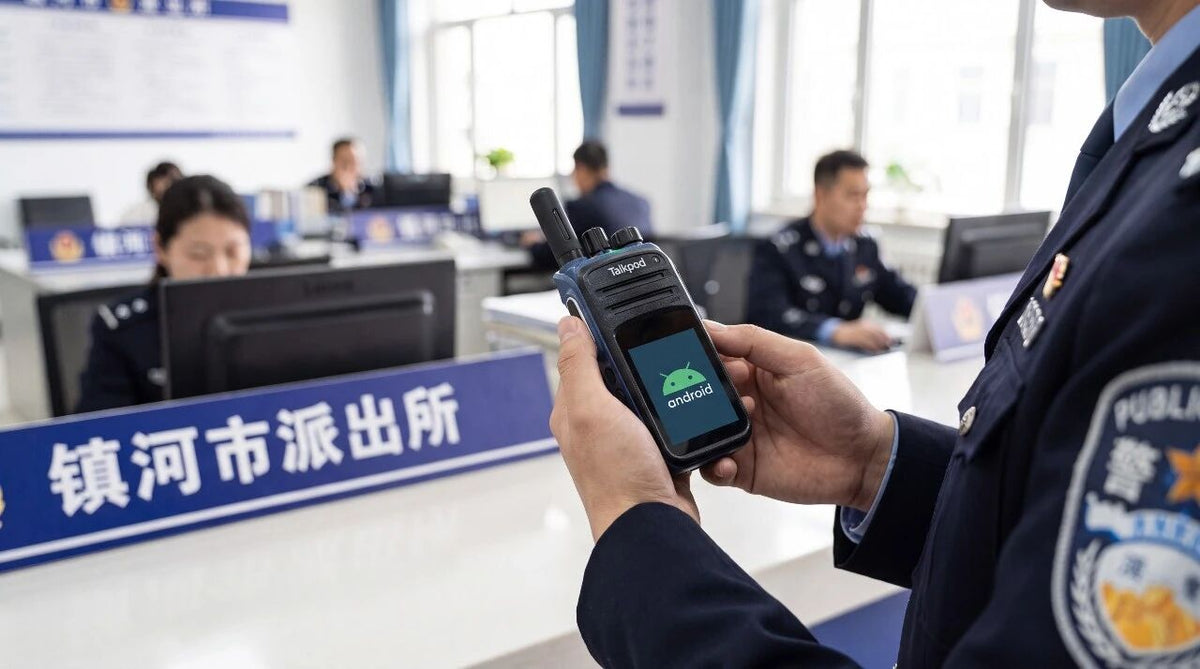
Frontline policing rarely happens in one place.
A local police station may cover dense residential neighborhoods, busy streets and villages several kilometers beyond the urban center. Officers move constantly between patrols, household visits, disputes and emergency calls. What happens in one location may require support from personnel working somewhere entirely different.
For Zhenhe Police Station, that geography created a communication problem. Conventional radios were useful for local communication but were constrained by direct radio range. Officers in the field could not always share visual information with the station quickly, while coordinating personnel across distant parts of the jurisdiction could take additional time.
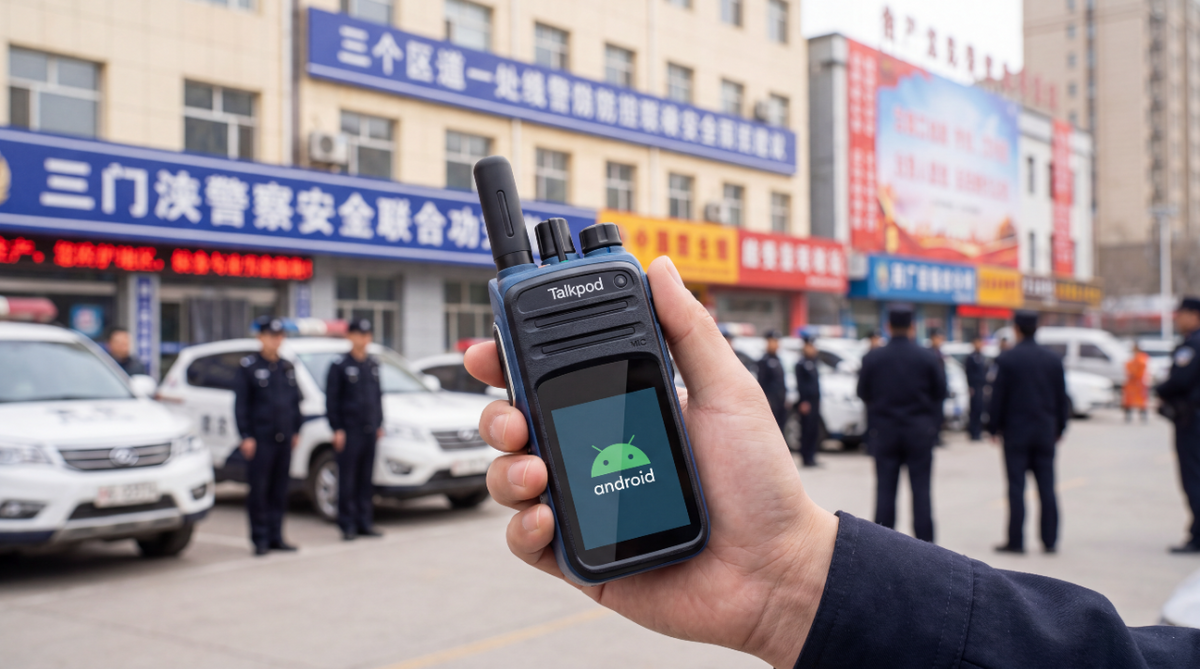
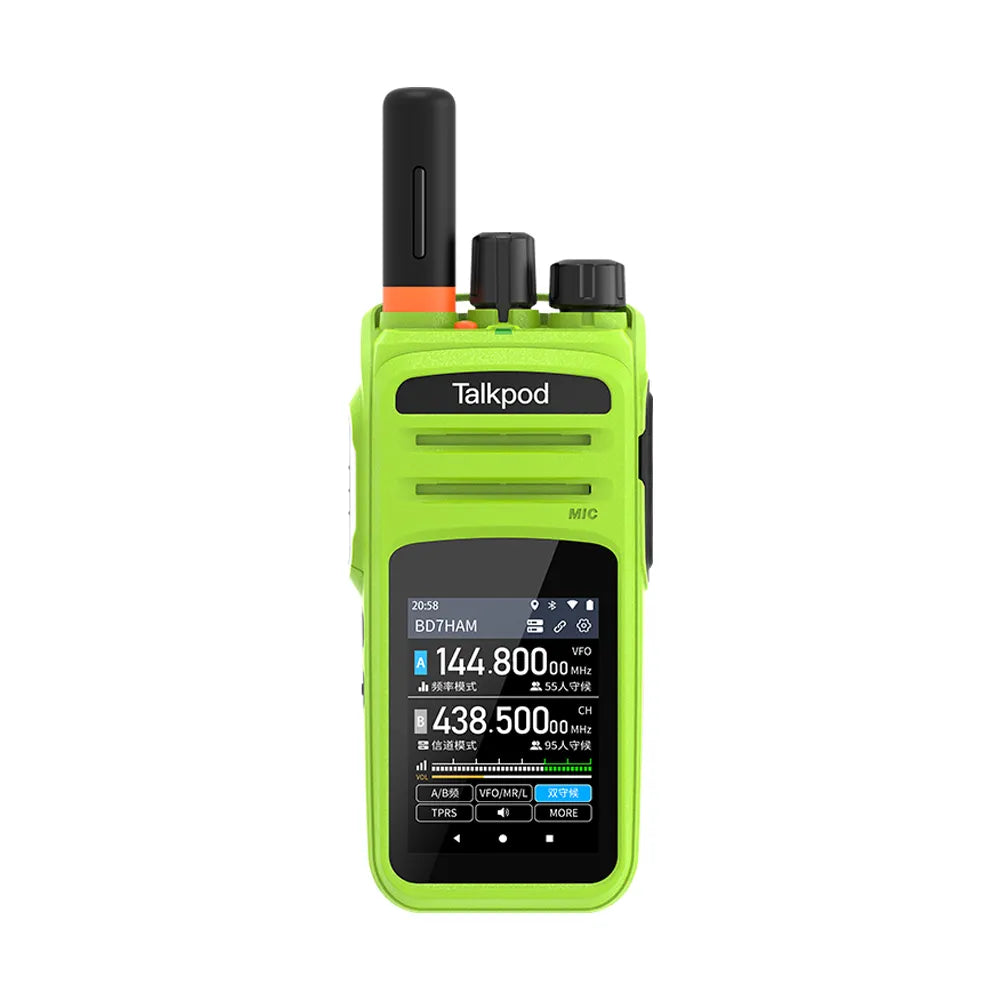
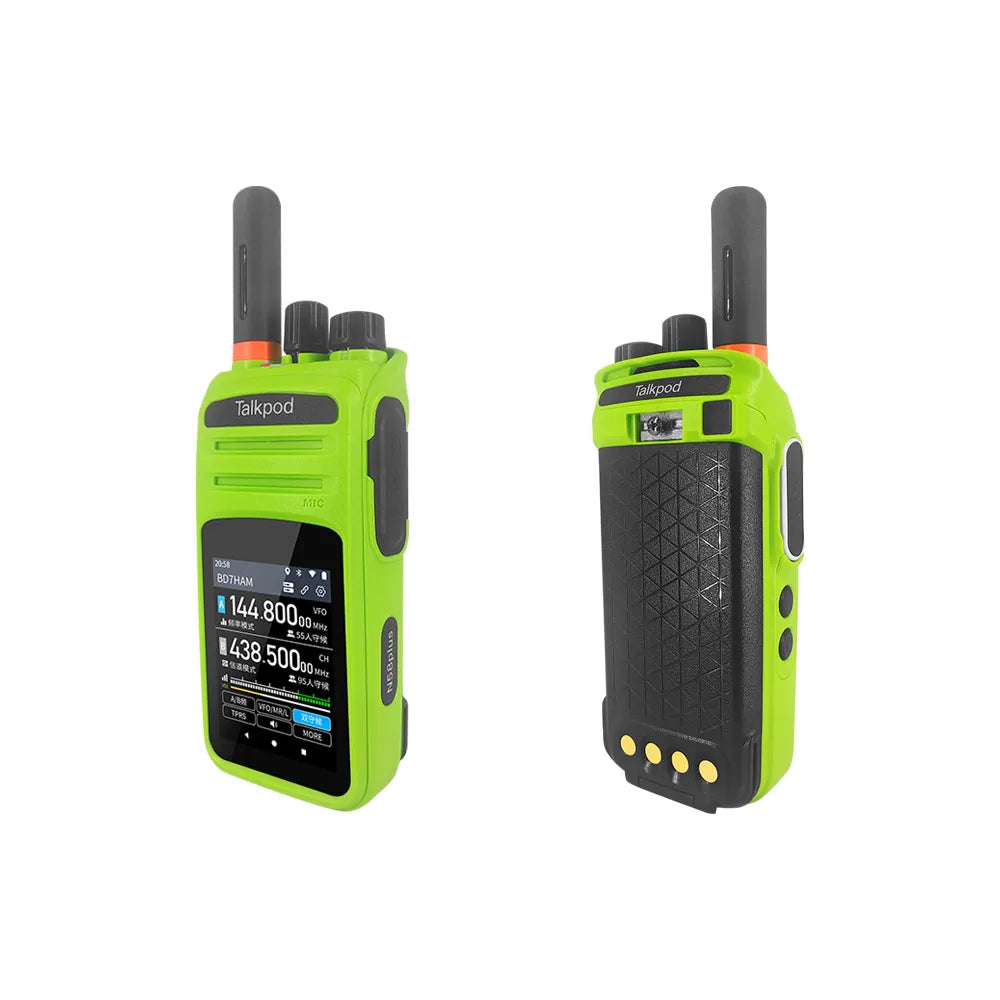
The Talkpod N59 smart public-network radio was introduced as an additional communication and information-sharing tool, combining wide-area push-to-talk with front and rear cameras and platform-based dispatch functions wherever suitable mobile-network service is available.
Connecting patrols across a mixed urban and rural jurisdiction
The area served by Zhenhe Police Station includes both older urban residential districts and more distant suburban villages.
That makes geography part of everyday policing. One team may be conducting a neighborhood visit while another is patrolling a main road and a third is responding to an incident outside the town center.
Using compatible public mobile networks, the N59 allows authorized personnel to communicate through managed push-to-talk groups without depending solely on the direct range between two handheld radios.
Officers and auxiliary personnel can therefore remain connected with the station while carrying out duties across different parts of the jurisdiction, provided that adequate network service is available.
This is particularly useful for routine coordination: updating patrol status, requesting another unit or informing the station that a situation is changing.
Public-network coverage is not universal, however. Remote villages, basements and heavily shielded buildings may still have weak or unavailable service. Coverage testing and alternative communication procedures therefore remain necessary.
[Image]
Adding visual context to a radio call
Voice can describe an incident. Images can sometimes explain it faster.
The N59 incorporates front and rear cameras that can support authorized image and video capture during field operations. Where platform configuration, network conditions and organizational policy permit, relevant visual information can be shared with the dispatch side to provide additional context.
During a street patrol or dispute response, for example, an officer may be able to show supervisors the general conditions at the scene rather than relying entirely on a verbal description.
That can help the station understand what resources may be required before additional personnel arrive.
The capability must be used within applicable laws, evidentiary rules, privacy requirements and departmental procedures. Recording or transmitting identifiable people is not simply a technical function; in a law-enforcement environment it is also a matter of authorization, data governance, retention and access control.
The N59 should therefore support established policing procedures rather than create a separate, informal recording system.
From field report to dispatch decision
An effective dispatch system does not merely collect information. It helps the organization decide who should respond next.
With field personnel connected through managed groups, a dispatcher can receive operational updates and coordinate available units according to the information provided by officers and the dispatch platform.
If a patrol encounters a situation requiring additional support, the officer can notify the relevant group without repeatedly making individual telephone calls. Personnel already operating nearby may then be assigned according to the station's own command procedures.
This can reduce unnecessary communication steps and help supervisors maintain a clearer picture of how resources are distributed across the jurisdiction.
The technology does not itself determine which officer should respond. Deployment decisions remain the responsibility of authorized police personnel using verified operational information.
Supporting routine community policing as well as incidents
Not every police interaction is an emergency.
Much of grassroots policing consists of household visits, neighborhood patrols, community engagement and mediation of everyday disputes. These activities are geographically dispersed and often involve officers working away from the station for extended periods.
The N59 allows personnel conducting these duties to remain connected with their working group. A developing situation can be reported without abandoning the location simply to return to the station.
This can also reduce unnecessary travel. If an officer needs clarification, additional personnel or information from another team, communication can begin from the scene.
For a local station covering both urban and rural areas, small reductions in repeated travel can add up across a working day.
Organizing communication around police responsibilities
A police station contains different roles and responsibilities, and not every communication should reach every user.
Managed talk groups can be configured around patrol areas, duties or operational requirements. Routine communication can remain within the appropriate group, while supervisors can coordinate across groups when an incident requires a broader response.
This makes the communication structure easier to manage than placing every user into one permanent channel.
Permissions and account management are equally important. Police communications may contain operationally sensitive information, so access should be restricted according to role and departmental policy.
Platform security, account management, device control and organizational procedures together determine the overall protection of the system. A smart public-network radio should not be treated as a substitute for communications systems specifically certified or mandated for sensitive or mission-critical police operations.
Training around the way officers actually work
Issuing a new device is the easy part. Changing how people communicate is harder.
Talkpod provided practical training based around everyday policing workflows, helping officers and auxiliary personnel become familiar with push-to-talk groups, multimedia functions and dispatch procedures.
Scenario-based training is particularly useful for devices such as the N59 because the technology combines several functions that were traditionally handled separately.
An officer must know not only how to initiate a call, but also which group to use, when visual information is appropriate, what should not be transmitted and how to escalate an incident through existing command procedures.
The aim is for the device to fit the workflow already understood by officers rather than forcing the workflow to revolve around the device.
Built for field duty
Police handheld equipment is used outdoors, carried in vehicles and handled repeatedly throughout a shift.
The N59 is designed for demanding field use and has undergone environmental-reliability testing associated with requirements such as drops, vibration and changing weather conditions.
Such testing can improve confidence in everyday durability, but terms such as “military-grade” should not be interpreted as meaning that the device is indestructible. Actual protection depends on the product's specified environmental ratings and proper maintenance.
A damaged device should be inspected before being returned to operational duty, particularly if its enclosure, battery or camera components have been affected.
A second layer of connectivity for frontline policing
After deployment, Zhenhe Police Station gained another way to connect personnel spread across its jurisdiction. Patrol teams could communicate over wider areas, field conditions could be shared with the station when authorized, and supervisors had more information available when coordinating support.
The N59 does not replace professional judgment, established command procedures or dedicated mission-critical police communications.
Its role is to connect several parts of frontline work that are often separated: the officer at the scene, the dispatcher at the station and the personnel who may be called to assist.
For grassroots policing, that connection matters because distance is often where coordination begins to break down.
A smart communication device cannot remove that distance. It can, however, make it less of an obstacle.

Leave a comment
All comments are moderated before being published.
This site is protected by hCaptcha and the hCaptcha Privacy Policy and Terms of Service apply.