
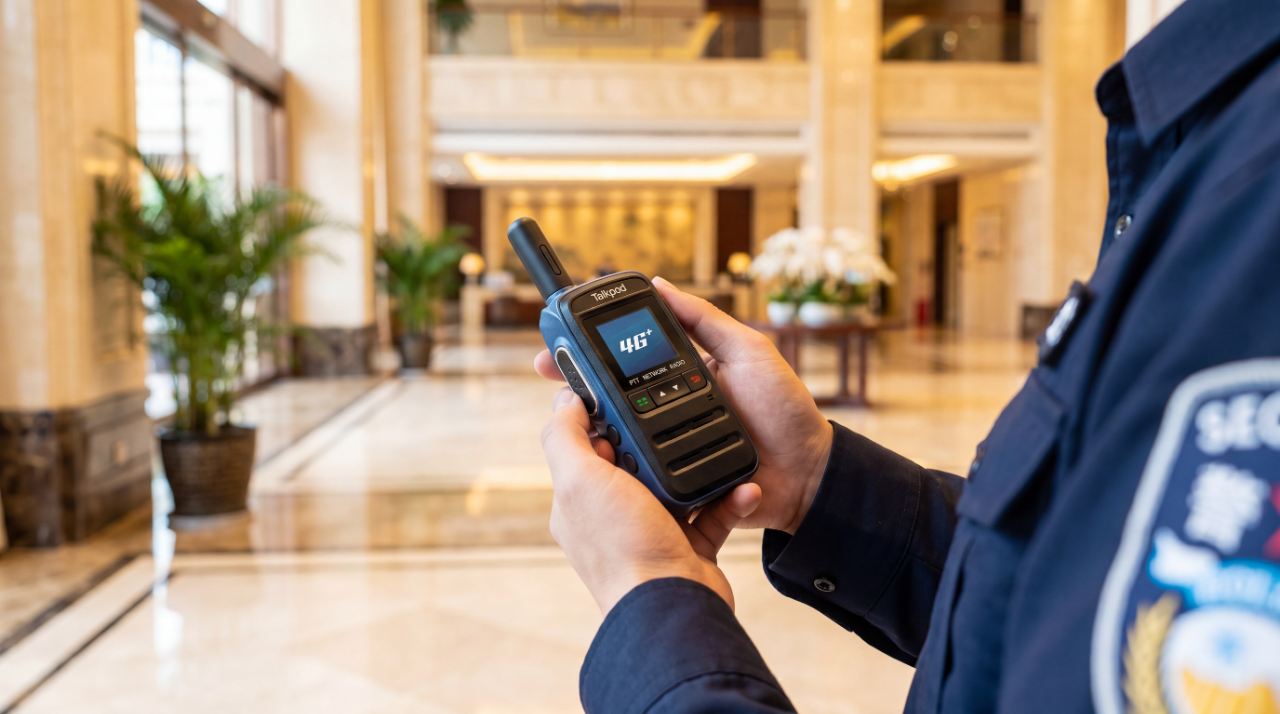
A hotel guest sees one service. Behind it are many departments.
The front desk handles arrivals and requests. Housekeeping moves between guest floors. Bell staff manage luggage. Engineers respond to faults, while banquet, restaurant and security teams operate elsewhere in the building. During a wedding, conference or busy check-in period, all of them may need to respond at once.
At Dongguan Kaibinli International Hotel, this coordination was complicated by the size and layout of the property. Guest rooms, banquet halls, Chinese and Western restaurants and back-of-house areas were spread across different floors and zones. Building structures could weaken conventional radio signals, while communication between distant teams was not always clear or immediate.
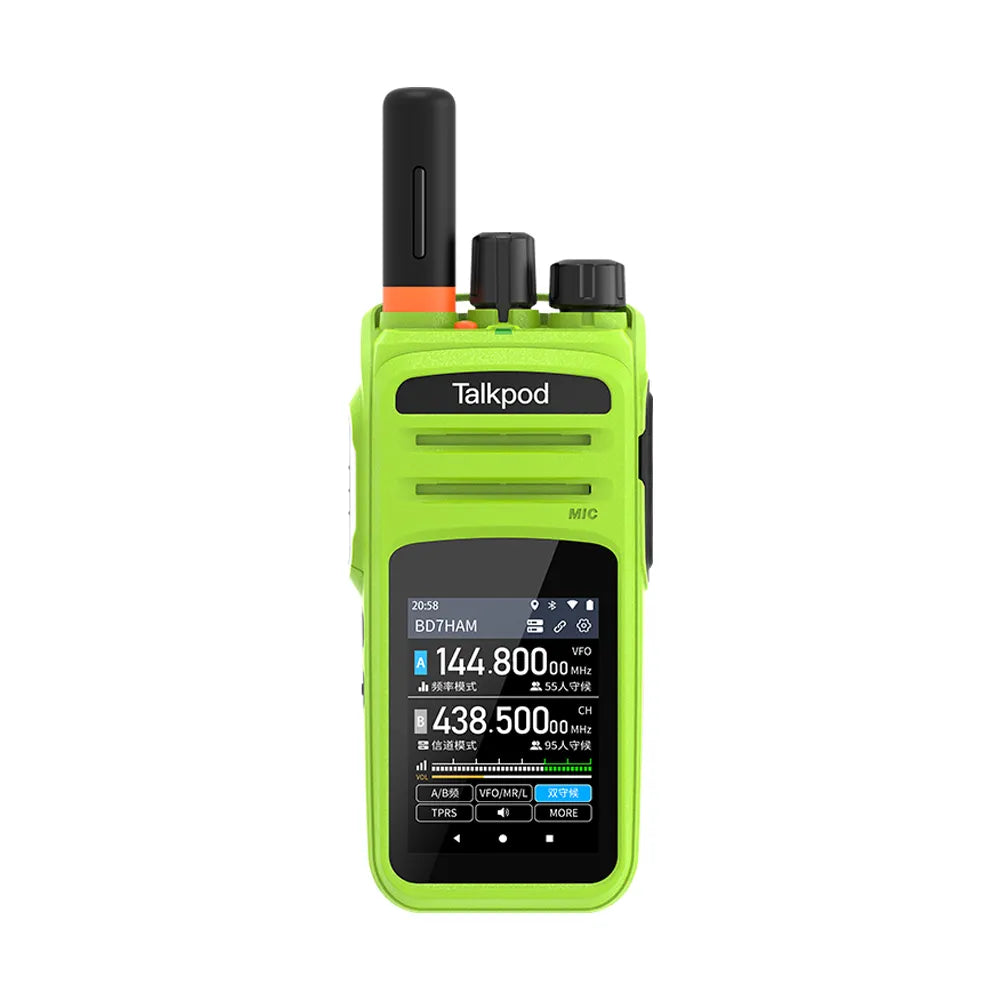
The Talkpod N15 public-network radio was introduced to give hotel staff a more flexible push-to-talk link across departments wherever compatible mobile-network coverage is available.
Connecting the front desk with the rest of the hotel
The front desk is often where a guest request begins, but rarely where it is completed.
A room may need to be prepared earlier than expected. Luggage may need to be collected. A meeting room may require additional chairs, lighting or technical support. Each request involves another department, and each delay becomes visible to the guest.
With the N15, front-desk staff can contact the appropriate housekeeping, engineering, bell-service or support group directly while continuing to serve the guest in front of them.
Instead of leaving the counter, making several telephone calls or waiting for a colleague to return a message, reception personnel can pass the operational request to the relevant team through push-to-talk communication.
The advantage is simple: the guest does not have to wait for the hotel’s internal communication to catch up with the request.
Coordinating busy weddings and conferences
Large events place unusual pressure on hotel operations.
A wedding banquet may require banquet staff, kitchens, engineering, security and reception to make adjustments within minutes. A conference organiser may change a room layout just before attendees arrive. Additional refreshments, microphones or signage may suddenly be required.
In these situations, a long chain of individual phone calls can slow the response.
The N15 allows operational groups to be organised around departments and event responsibilities. Staff responsible for the same function can receive a group instruction, while individual calls can be used when a request concerns only one employee or task.
This helps supervisors coordinate several teams without filling every user’s radio with unrelated traffic.
For a hotel, that distinction matters. Good communication is not about everyone hearing everything. It is about the right department hearing the right request quickly enough to act on it.
Clearer communication across different working environments
Hotels are not uniformly quiet.
A lobby may be crowded with arriving guests. A banquet hall can be filled with music and conversation. Kitchens and engineering rooms have their own background noise.
The N15 uses digital voice processing and a high-output speaker to provide louder and clearer speech in these environments. This can make short operational messages—room numbers, locations, equipment requests and staffing instructions—easier to understand without repeated calls.
Staff should still avoid broadcasting unnecessary guest information. Names, contact details, payment information and other sensitive data should remain within the hotel’s approved information systems and privacy procedures.
The radio is most useful for coordinating the service around the guest, rather than discussing the guest in detail.
[Image]
Using public networks to communicate between floors
High-rise hotels can be challenging environments for traditional direct radio systems. Concrete floors, walls, lifts and service areas all influence radio propagation.
The N15 uses compatible public mobile networks rather than depending only on a direct radio link between two users. This can provide greater flexibility when employees are working on widely separated floors or in different buildings.
Performance will nevertheless depend on network availability. Lifts, basements, plant rooms and heavily shielded back-of-house areas may have weaker cellular service.
Coverage should therefore be tested throughout important operational locations before deployment, particularly at the front desk, guest floors, kitchens, banquet spaces, loading areas and engineering rooms.
The aim is not to promise that every corner of the hotel will always have a signal. It is to create a communication structure that makes better use of the networks available across the property.
Dual SIM support adds network flexibility
Network performance can vary even within the same building.
One operator may provide stronger service on guest floors, while another performs better in a basement or back-of-house area. The N15 supports two SIM cards, allowing compatible services from different operators to be configured.
This gives hotel teams another option when local network conditions vary. Depending on configuration and service availability, the device can make use of the more suitable connection.
Dual SIM capability should not be treated as a guarantee against disconnection. If both networks are weak in a particular location, communication may still be affected.
For a large hotel, however, having access to more than one network can make deployment more adaptable to the building’s actual conditions.
Building communication groups around hotel operations
A hotel has many departments, but not every department needs to hear every call.
Talkpod configured a nested group structure around the hotel’s operating requirements, with particular attention to front-desk coordination. Reception personnel could reach the appropriate operational teams while departments retained their own working groups for routine communication.
Housekeeping requests could remain with housekeeping. Engineering faults could be directed to technical staff. Event-related calls could be organised around the personnel responsible for that function.
This reduces unnecessary radio traffic and makes communication easier to follow during busy periods.
It also allows the system to reflect the hotel’s service structure rather than forcing all employees onto one shared communication channel.
Keeping radios ready at the front desk
A communication system is only useful when the equipment is ready for the next shift.
Talkpod also provided a dedicated charging dock suited to storing spare units at the front desk. Radios could be placed in a fixed charging location between shifts, making it easier for reception staff to keep backup devices organised and ready for use.
This may seem like a minor operational detail, but hotels run continuously. A device returned with a low battery at the end of one shift can become somebody else’s problem at the beginning of the next.
Centralised charging helps turn radio management into a routine rather than an emergency.
Making service feel more immediate
After deployment, staff gained a more direct way to pass guest requests between departments. Front-desk personnel could continue handling check-ins while coordinating luggage, room preparation, engineering or meeting-room support elsewhere in the hotel.
The N15 does not make a bed, carry a suitcase or prepare a banquet hall. Nor does it replace the hotel’s property-management, work-order or guest-service systems.
It connects the employees responsible for those tasks.
For guests, that connection is largely invisible. They notice the result instead: a request acknowledged sooner, a room prepared more quickly or a member of staff arriving without another round of explanations.
In hospitality, service quality is often measured in minutes. Better communication helps ensure fewer of those minutes are spent waiting for one department to find another.

Leave a comment
All comments are moderated before being published.
This site is protected by hCaptcha and the hCaptcha Privacy Policy and Terms of Service apply.