
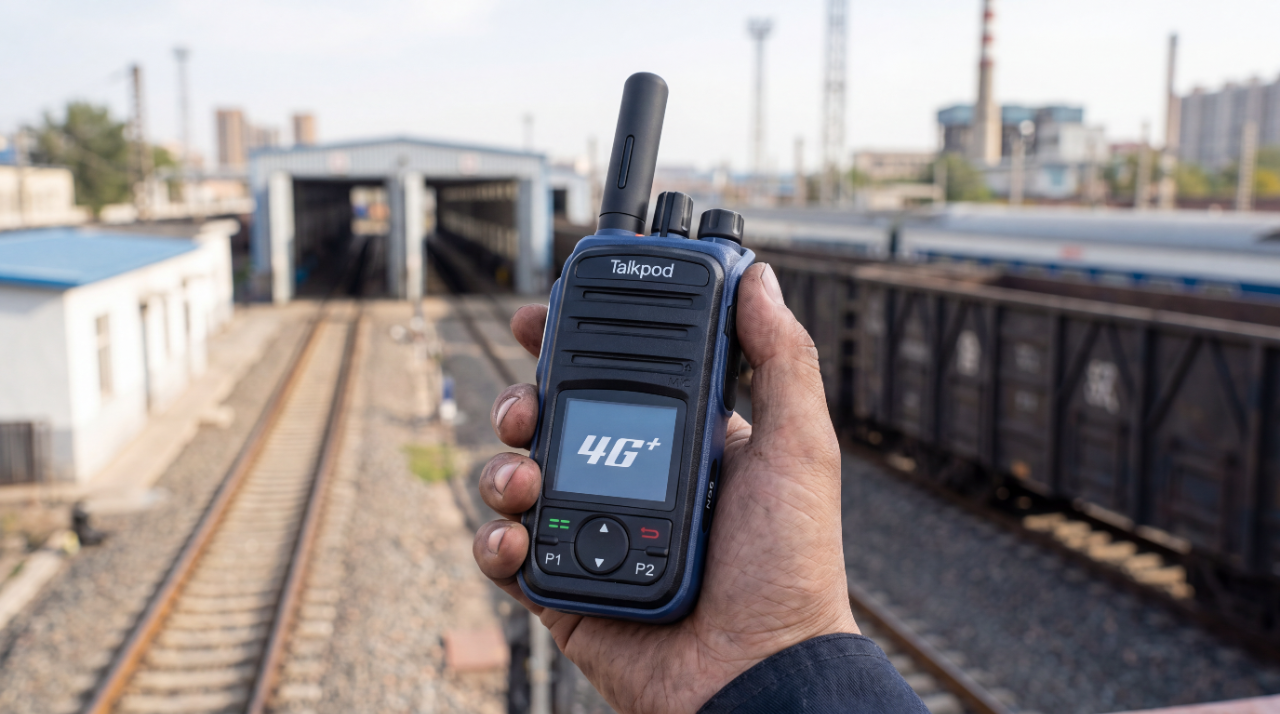
Railway maintenance around Urumqi can place considerable distance between the people who find a problem and the people responsible for coordinating its response.
Inspection and maintenance work may extend across open desert terrain, mountainous areas and widely separated operating points. Teams working outdoors can be exposed to wind, dust, low temperatures and substantial background noise, while supervisors need to coordinate personnel who may be many kilometers apart.
Conventional short-range radio systems can become difficult to use once crews move beyond their local coverage area.
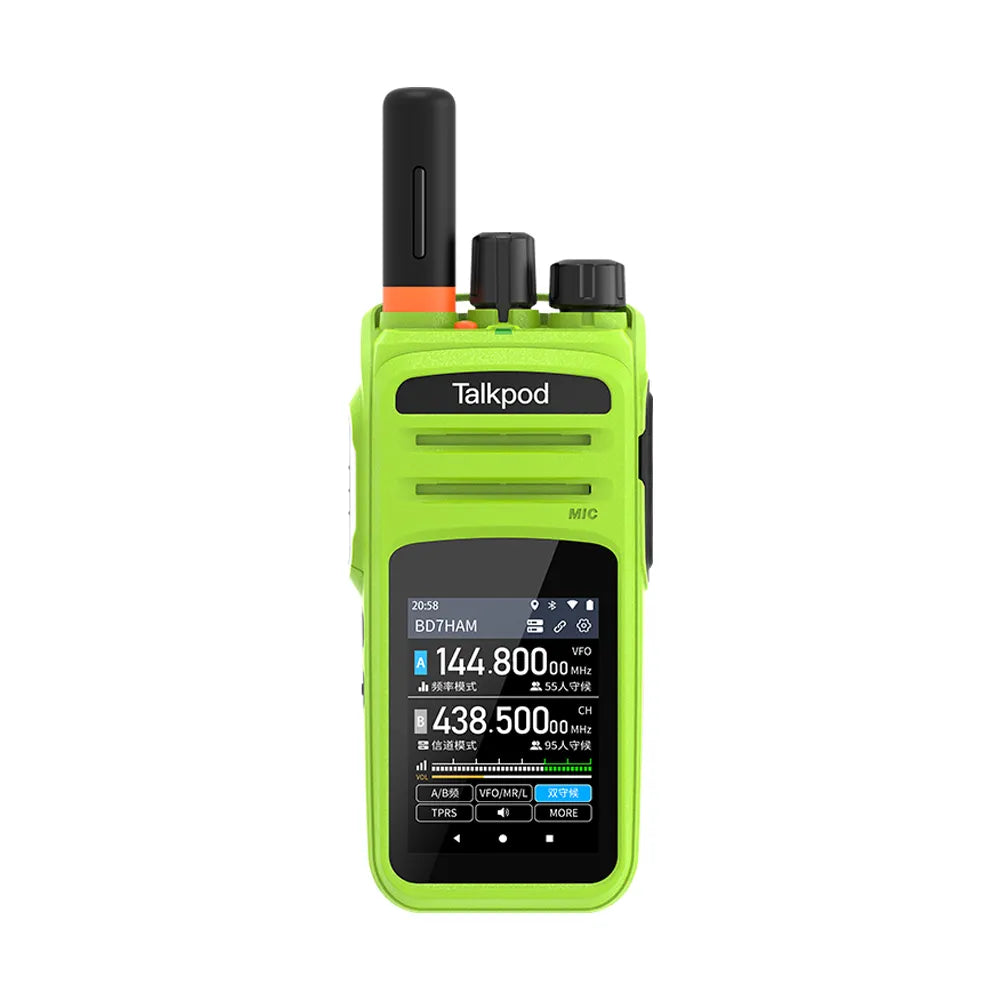
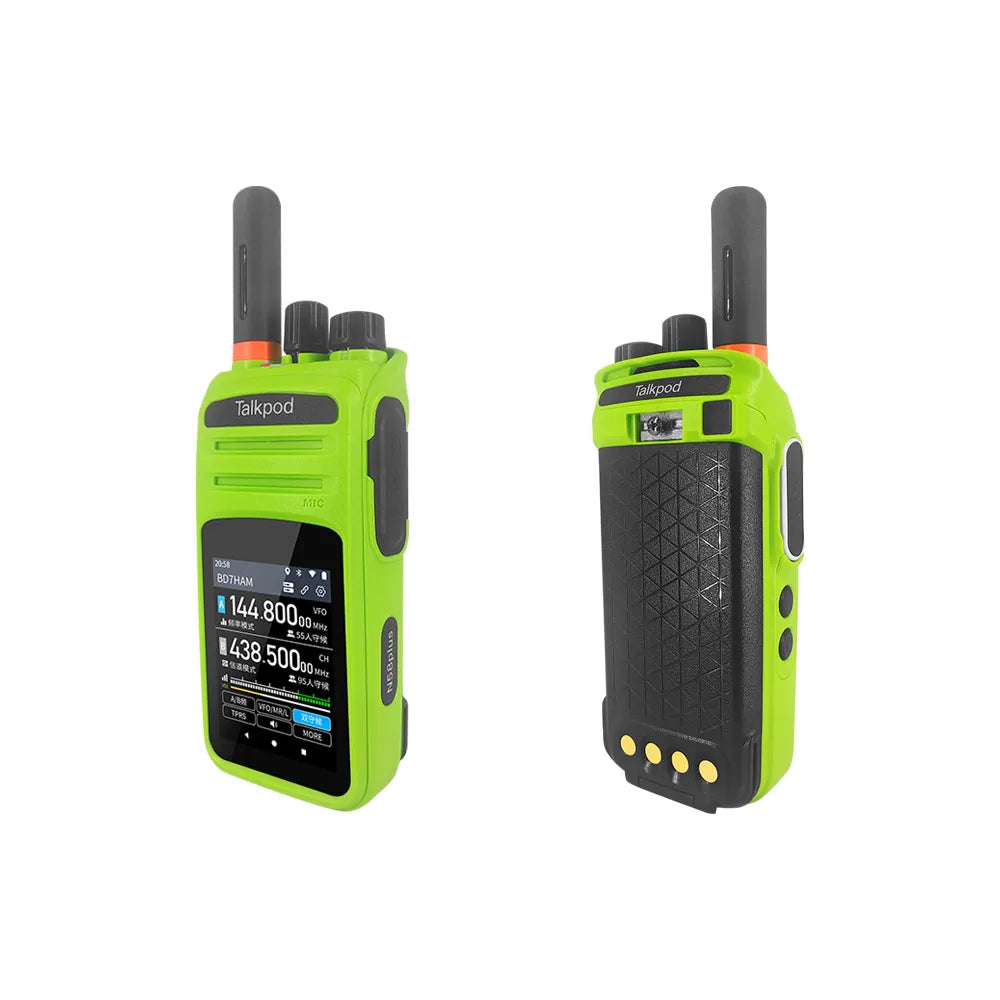
The Talkpod N56 public-network radio provides a wider-area push-to-talk communication layer for these distributed railway teams wherever compatible mobile-network coverage is available. Combined with digital voice processing, a color display and remote dispatch capabilities, it can help maintenance personnel and coordinators exchange operational information more quickly across dispersed work locations.
[Image]
Connecting widely separated maintenance points
The practical communication challenge for a railway depot is often geographical.
A maintenance worker may be inspecting equipment at one outdoor point while another team is working farther along the operating area and supervisors remain at a central location.
With a conventional local radio system, communication becomes increasingly dependent on range, terrain and infrastructure.
The N56 uses public mobile networks rather than relying solely on direct radio-to-radio coverage. This allows personnel at different locations to remain within the same managed push-to-talk system when suitable network service is available.
For routine maintenance work, that means a technician can report a defect without first returning to a fixed office or passing the information through several intermediate contacts.
The benefit is not “unlimited distance” in the literal sense.
It is the ability to extend team communication beyond the normal range of local handheld radios by using existing mobile-network infrastructure.
Faster reporting from outdoor inspection teams
Field maintenance becomes more efficient when information moves while the worker is still at the inspection point.
Using the N56, personnel can report component abnormalities, maintenance progress and requests for additional support directly from the work site.
This shortens the communication path between inspection and coordination.
A supervisor can receive the report, contact another team and adjust the work arrangement without waiting for the original worker to return to a depot or maintenance base.
Digital voice processing and speaker output can also help make short operational messages easier to understand around machinery, vehicles and windy outdoor environments.
For safety-critical information, however, clarity should not be assumed from a single transmission. Important instructions should still be repeated, acknowledged or documented according to the railway operator's procedures.
Remote dispatch for distributed teams
Once maintenance personnel are spread across a large operating area, communication becomes a management issue as well as a radio issue.
A dispatch platform can help organize radio accounts, user groups and communication relationships so that supervisors do not have to treat every device as an isolated endpoint.
Talkpod configured N56 accounts for the deployment and provided operational training to help personnel use the system consistently.
Groups can be arranged around actual work responsibilities, allowing maintenance personnel to communicate primarily with the people relevant to their task while supervisors retain the ability to coordinate across several teams.
This reduces unnecessary radio traffic and makes the communication structure easier to manage as personnel move between assignments.
One-touch alerts for abnormal situations
Outdoor railway maintenance occasionally places personnel far from nearby colleagues.
The N56 includes a one-touch alert function that can provide an additional way for a worker to notify designated personnel when an abnormal or urgent situation occurs.
The feature is most useful when the response process is defined in advance: who receives the alert, how it is acknowledged and what the next action should be.
An alert button should not be treated as an automatic rescue system.
Its effectiveness depends on device configuration, platform availability and network connectivity, and it should complement the railway operator's established emergency procedures rather than replace them.
Public-network coverage has limits in desert and mountain terrain
Wide-area PoC communication can reduce many of the distance limitations associated with conventional handheld radios, but it remains dependent on mobile-network infrastructure.
That distinction is particularly important around Urumqi.
Mountain terrain, remote sections, cuts and sparsely covered areas can all affect network availability. Even when coverage maps suggest service exists, actual performance can vary with terrain and local infrastructure.
Before deployment, the railway operator should therefore test the N56 along the real routes and work locations used by maintenance teams.
Areas with weak or unavailable service should be identified in advance, with alternative communication procedures retained for those locations.
For railway operations, public-network radios should also be treated as a supplementary coordination tool. Dedicated railway communication, signaling, train-control and other safety-critical systems required by the operator remain responsible for formal railway operating authority and safety-critical communication.
[Image]
Designed around demanding field work
Railway maintenance personnel do not work in office conditions.
They may use radios while wearing gloves, carrying tools or moving between outdoor inspection points. Dust, wind and low temperatures can also make unnecessarily complicated controls harder to operate.
The N56's color display and straightforward controls help reduce the number of steps required for routine communication tasks.
For sustained outdoor deployment, however, equipment should always be used within its specified environmental ratings. Cold-weather performance, battery endurance and enclosure condition should be checked as part of normal fleet maintenance rather than assumed from general ruggedness alone.
Support continues after deployment
A communication system is not finished when the radios are handed over.
Accounts need to remain organized, user groups may change and new personnel need to understand the operating procedure.
For the Urumqi deployment, Talkpod provided account configuration, user training and continuing backend support.
That service layer can be as important as the hardware itself.
When devices, groups and users are managed consistently, maintenance teams spend less time figuring out how to reach one another and more time dealing with the actual work in front of them.
For a railway depot operating across large and difficult terrain, the N56 is therefore best understood not as a replacement for dedicated railway communication systems, but as an additional wide-area coordination layer.
Where suitable mobile-network coverage exists, it can reduce the distance between an outdoor maintenance worker and the team responsible for responding to what that worker finds.

Leave a comment
All comments are moderated before being published.
This site is protected by hCaptcha and the hCaptcha Privacy Policy and Terms of Service apply.