
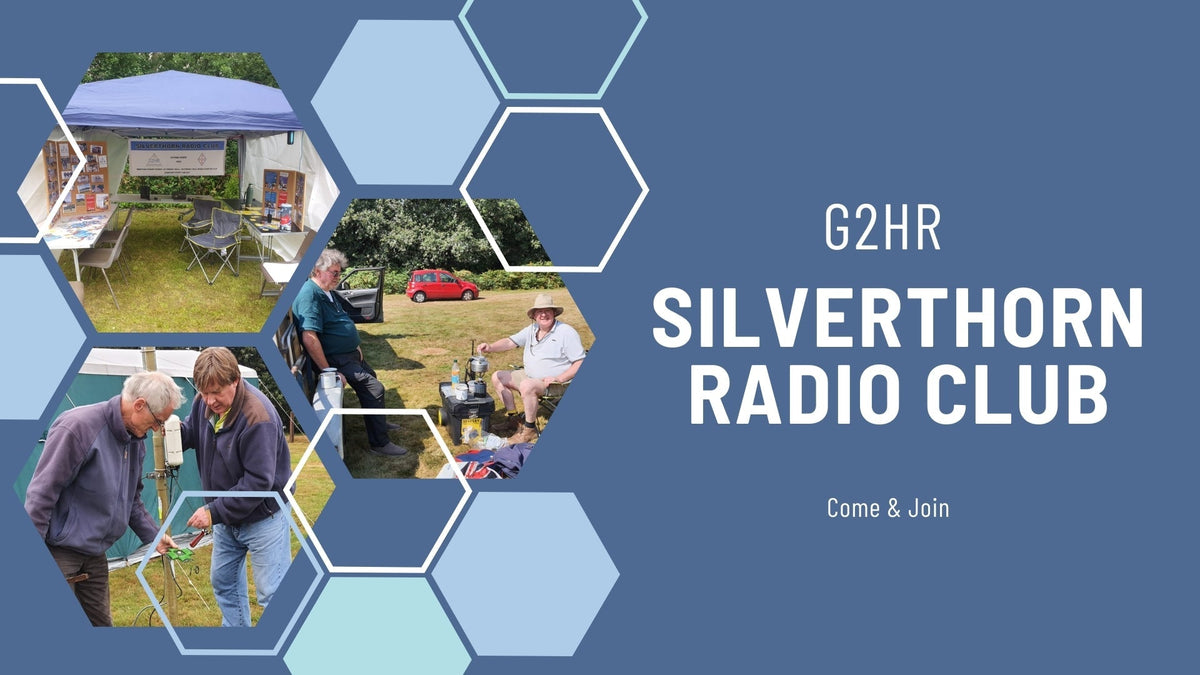
Based in Chingford, North-East London, the Silverthorn Radio Club, associated with the callsign G2HR, has a history stretching back more than seven decades.
Contemporary amateur-radio records show that the club was already well established by the 1950s. A 1967 profile in Practical Wireless described Silverthorn as having been formed roughly fifteen years earlier by G2HR and short-wave listener R. Cason, placing its origins in the early 1950s. Historical photographs also document Silverthorn members taking part in Field Day activities as far back as 1958.
Today, the club remains based in Chingford and continues to provide a regular meeting place for people interested in amateur radio, electronics and radio technology.
Friday Evenings at Friday Hall
Silverthorn Radio Club continues to meet at:
Friday Hall
56 Friday Hill East
Chingford
London E4 6JT
The Chingford Community Association continues to list Silverthorn Radio Club among the groups based at Friday Hall.
Recent Radio Society of Great Britain (RSGB) listings show that the club meets on Friday evenings from around 8:00 PM. Earlier listings sometimes gave a 7:30 PM start, so visitors may wish to contact the club before travelling if they need the precise opening time for a particular week.
The club has a long association with Friday Hall and its predecessor community facilities in Chingford. Earlier RSGB records describe a dedicated club shack equipped with a workbench, radio equipment and permanent antennas, giving members an opportunity to operate and experiment from a shared station.
A Club with a Strong Technical Tradition
Silverthorn's history reflects the practical side of amateur radio.
Over the decades, its members have participated in Field Days, contests, portable operating and technical projects, while the club station has provided a place for operators to exchange knowledge and gain hands-on experience.
That technical tradition remains visible today.
In 2026, Icom UK's Amateur Radio Specialist Chris Colclough (G1VDP) visited Silverthorn Radio Club to give members a presentation on Icom's history and current amateur-radio equipment.
During the evening, an Icom IC-7300MK2 was connected directly to the club antenna system. A German CW station on the 40-metre band was used to demonstrate the radio's CW decoding capabilities, while club members were able to explore the transceiver's controls, menus and operating features for themselves.
Rather than being simply a lecture, the visit provided the kind of hands-on technical exchange that has long been part of amateur-radio club life.
More Than Seven Decades of Amateur Radio
Silverthorn's longevity is one of its most distinctive characteristics.
Records from the 1960s already describe club members operating portable stations and participating in contests and annual field activities. In the decades that followed, the club continued to meet in Chingford while amateur radio evolved from valve transmitters and analogue receivers to today's SDR transceivers and digital technology.
A 2025 project documenting the archives of the Chingford Community Association uncovered thousands of historic documents and photographs, including images of Silverthorn's 1958 Field Day. The same community history describes the radio club as continuing to operate and welcome new members.
That continuity gives Silverthorn an interesting position within London's amateur-radio community: a club whose roots belong to the post-war era of home-built equipment and short-wave experimentation, but which continues to engage with modern transceivers and contemporary radio technology.
Visiting Silverthorn Radio Club
Those interested in amateur radio, whether already licensed or simply curious about the hobby, can contact the club before attending a Friday meeting.
The most recent RSGB listings give the club contact as:
Colin Carter (2E1FQE)
Club Secretary
Email: colin.carter@btinternet.com
Colin's role as club secretary was also confirmed during Icom UK's 2026 visit to Silverthorn.
Keeping G2HR on the Air
For Silverthorn Radio Club, amateur radio has always involved more than simply making contacts.
Its history encompasses operating, experimentation, equipment construction, Field Days and the exchange of technical knowledge between radio enthusiasts. From the club's early years in the 1950s to demonstrations of modern SDR transceivers in 2026, radio technology has changed enormously, while the basic attraction of experimenting, learning and getting on the air remains.
More than seventy years after its beginnings, Silverthorn Radio Club continues to meet in Chingford, keeping a long-established part of North-East London's amateur-radio history alive.


Leave a comment
All comments are moderated before being published.
This site is protected by hCaptcha and the hCaptcha Privacy Policy and Terms of Service apply.